What Month Has The Best Weather In Kauai?
Find out which month brings the calmest seas, lowest rain, and best conditions for a Napali Coast boat tour, backed by real Kauai weather data.
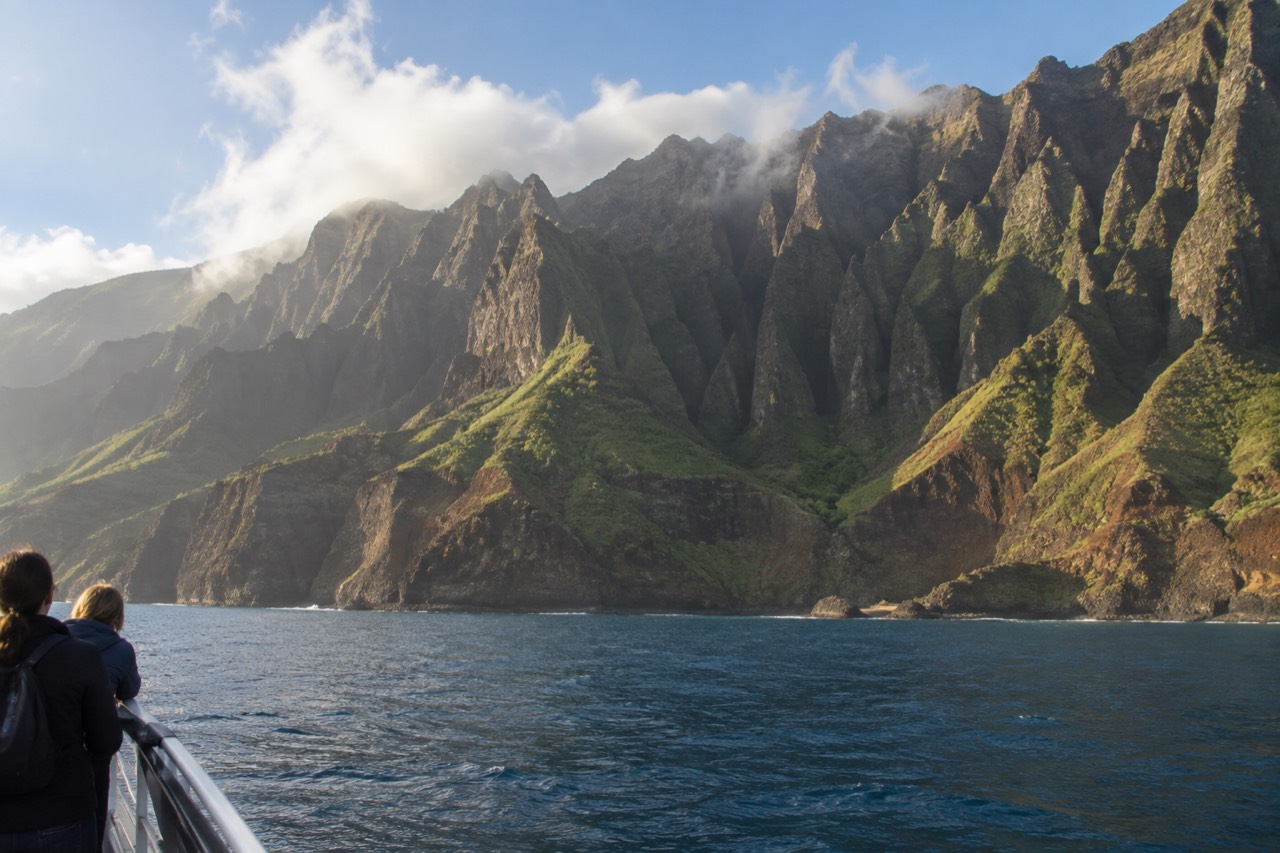
Kauai’s west side receives less than half the annual rain of its north shore, but the real weather question for a boat tour is swell, not rainfall. A sunny day with a 10-foot north swell can keep even the largest catamarans away from the Napali sea cliffs, while a light drizzle on a flat ocean makes for a perfectly good cruise. When you are building a trip around a boat day with Napali Coast Boat Tours, the month you choose does more than set the temperature: it picks the sea state, the wind, and the odds of getting inside a sea cave.
Which Month Has Kauai’s Best Weather?
April through October delivers the most reliable combination of low rainfall, moderate trade winds, and calm sea state for a Napali Coast boat tour. July and August offer the highest trade-wind frequency and the smallest offshore swells, making them the safest bet for snorkeling and cave access, though these are also the busiest months on the water.
The “best weather” question splits into two parts: what feels pleasant on land, and what keeps the ocean flat enough for a small boat. On land, temperatures at sea level stay warm year-round; Lihue Airport’s January mean maximum is 78.6 °F and Waimea’s annual maximum temperature averages 83.5 °F, so the real difference between seasons is rain, not cold. The north shore and Mount Waiʻaleʻale can see over 400 inches of rain a year, while the west side near Waimea averages under 20 inches. For a boat tour departing Port Allen or Kikiaola, you are launching from the dry side, so afternoon showers are rare. The bigger variable is the swell running against the Napali cliffs from November through March.
Measured offshore wave data shows that July and August record significant wave heights below 2.5 meters more than 98% of the time, while January sits above 2.5 meters roughly half the month. That shift is what makes a July snorkel stop at Nualolo Kai feel effortless and a January attempt unlikely. The trade-off is crowds: Kauai saw 139,974 visitor arrivals in July 2026 alone, and the calmest months fill the soonest. Booking a Kauai trip in the spring or fall shoulder can land you similar conditions with thinner crowds, though you may trade a few more windy afternoons.
A three-tour spread like the one above gives you a sunset option, a full-day lunch cruise, and a raft snorkel, each of which performs differently across the calendar. The raft snorkel tour shines from May through September when the swell is smallest, while the sunset cruise aboard ‘Imiloa runs year round and can be a smart pick in October or April when afternoon winds settle early.
How Much Does Rain Vary By Shore?
Rainfall on Kauai is among the most extreme on Earth, with the summit of Mount Waiʻaleʻale averaging over 400 inches per year while the leeward west side near Waimea sees fewer than 20 inches. A boat tour departing from Port Allen or Kikiaola sits on the dry side, so morning rain is uncommon, but the north shore and the interior mountains can be soaked even when the boat ramp is dry.
The official 1991-2020 normals from NOAA’s National Centers for Environmental Information underline the split. Lihue Airport, on the island’s east side, records 36.22 inches of rain a year over 192.6 wet days, with January alone bringing 2.78 inches across 12 days. By contrast, Waimea’s station data shows a much drier profile, with January’s mean maximum temperature at 79.5 °F and an annual precipitation total far below Lihue’s. The west side sits in the rain shadow of the central mountains, so the boat harbors at Port Allen and Kikiaola rarely see the kind of persistent rain that can wash out a day hike on the Kalalau Trail.
That rain-shadow effect is what makes a boat tour a reliable bet even when the north shore is under a flash flood watch. The Napali Coast itself catches more moisture than the departure harbors because the cliffs force warm trade-wind air upward, but from the water you are watching the waterfalls, not standing under them. A light jacket is enough on most days, and a rain shell layered over a swimsuit handles the occasional passing shower.
The Express Na Pali Sunset Tour aboard ‘Imiloa is one of the tours that benefits directly from the west side’s dry pattern. Its late-afternoon departure catches the cliffs in golden light, and because it launches from Port Allen, the check-in and boarding happen in the island’s sunniest corner, not under a north-shore cloud bank.
What Is The Windiest Season?
Winter brings the strongest large-scale winds to Kauai, driven by passing cold fronts and extra-tropical storms that can push sustained winds above 25 knots. The summer months see lighter and more predictable trade winds, which peak in frequency but rarely reach the gusty, disruptive speeds of a winter front.
The trade winds themselves blow from the northeast most of the year, but their strength and reliability shift. In winter, from November through March, the North Pacific storm track sends frontal systems sweeping across the island chain, each one capable of whipping up 20- to 30-knot winds for a day or two before the trades re-establish. These frontal passages are the events most likely to cancel or reroute a boat tour, not the steady trade-wind afternoons of summer.
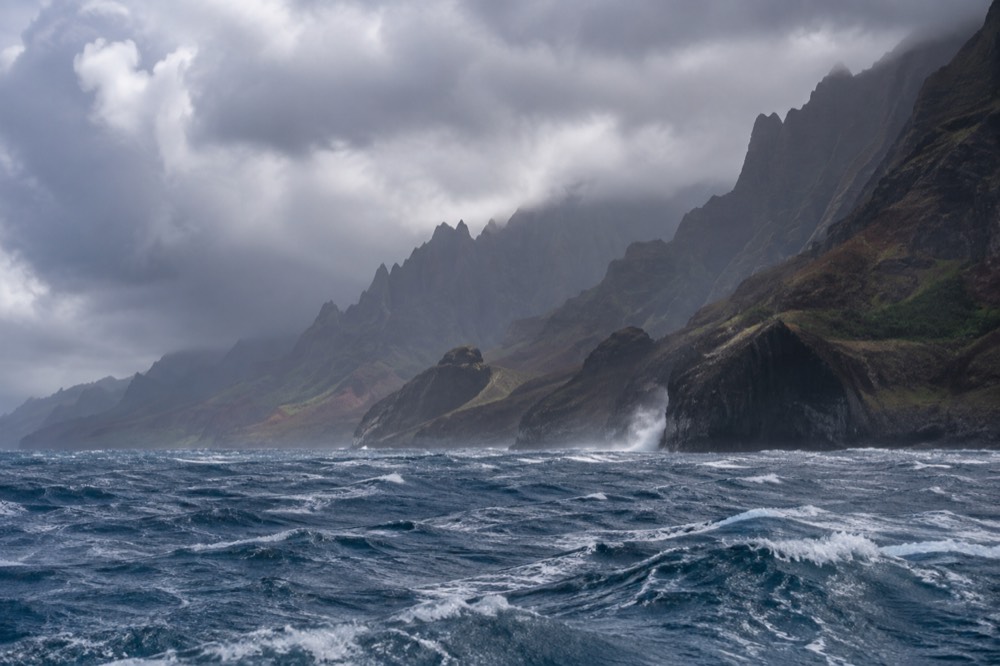
By July and August, the trades are at their most consistent, blowing 15 to 20 knots through the afternoon and easing after sunset. That is why many operators schedule snorkeling in the morning and sunset cruises in the late afternoon: the window between the trade-wind peak and the evening calm is narrow but predictable. A sunset cruise timed for the last two hours of daylight often rides the smoothest water of the day.
Does Good Weather Mean Calm Water?
Sunny skies and light rain do not guarantee a calm ocean. The swell that reaches the Napali Coast is generated by storms thousands of miles away, so a beautiful beach day can still produce seas too rough for a small boat to round the cliffs. The sea state, measured as significant wave height, is the metric that matters most for a boat tour.
Two full years of data from the NOAA Waverider buoy 51208 off Hanalei show the seasonal swing in offshore wave height. The table below uses observations from 2024 and 2025, a recent two-year window, to illustrate how often the swell exceeds thresholds that make boat handling difficult. Note that these are offshore measurements in 200 meters of water, not breaker height at the shoreline, but they track the swell energy that reaches the Napali cliffs.
| Month | Mean Hs (m) | Share of Obs ≥ 2.5 m | Share of Obs ≥ 3.5 m |
|---|---|---|---|
| January | 2.77 | 52.2% | 24.0% |
| February | 2.47 | 47.5% | 4.4% |
| March | 2.12 | 28.3% | 2.4% |
| April | 1.93 | 16.3% | 3.9% |
| May | 1.73 | 5.6% | 0.0% |
| June | 1.61 | 0.2% | 0.0% |
| July | 1.50 | 0.1% | 0.0% |
| August | 1.40 | 1.6% | 0.0% |
| September | 1.42 | 0.1% | 0.0% |
| October | 1.76 | 10.8% | 0.2% |
| November | 2.42 | 42.6% | 3.8% |
| December | 2.61 | 46.4% | 16.2% |
The pattern is clear: June through September the swell almost never reaches 2.5 meters, while December and January sit above that threshold roughly half the time. April and October are genuine shoulder months, with swell energy building or receding, and a boat day in those months is more of a coin flip. Rain, by contrast, does not cancel tours; every operator checked states that light rain does not stop a trip, and only lightning or unsafe sea conditions trigger a cancellation.
Which Months Suit A Boat Day?
May through September is the core boat-tour window on the Napali Coast, with July and August offering the highest chance of calm seas, cave entry, and snorkeling. April and October are reliable shoulder months for west-side departures, while November through March demands flexibility and a willingness to switch to a south-shore or sunset-only itinerary.
West-side operators run tours year round, but the product mix shifts with the swell. Captain Andy’s, for example, runs its morning raft snorkel all year, but adds a shorter afternoon raft cave patrol only from mid-May to mid-September, and swaps in a whale-watch trip that stays on the south shore from December through March. Kauai Sea Tours similarly offers its raft beach landing only from May to October, while its sunset dinner sail runs September to May, and its whale watch operates December to March along the south shore. The same pattern holds across the roster: a winter visitor can still board a boat, but the itinerary may skip the caves, drop the snorkel stop, or stay south of the Napali cliffs entirely.
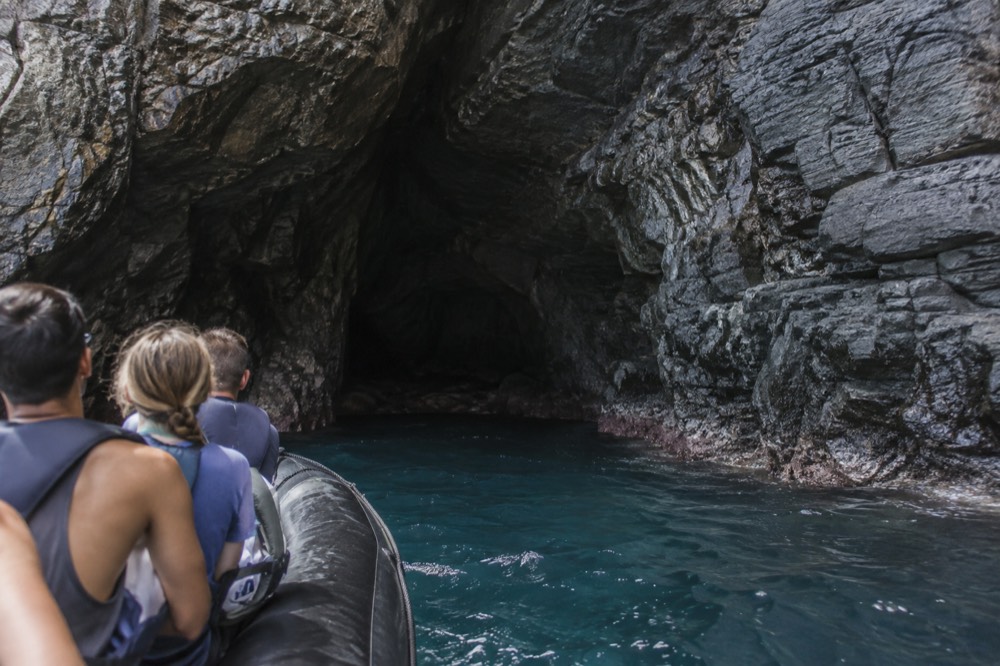
For a visitor who wants the full experience (snorkeling, caves, and the full coastline), the data points squarely at July and August. Those months combine the smallest swell, the most consistent trade winds, and the longest daylight. The trade-off is competition: Kauai recorded 128,883 visitor arrivals in June 2026 and 139,974 in July, so the calmest weeks also have the most people on the water. A September or early October trip often delivers nearly flat seas with half the crowd, though the days are shorter and the afternoon trades can be less predictable.
The Express Na Pali Sunset Tour aboard ‘Imiloa is one tour that works well across many months because it launches in the late afternoon when winds often ease, and it does not depend on snorkeling or cave entry. It is a strong pick for April, October, or even a calm winter day when the operator confirms the route will reach the Napali cliffs.
What Is Trade Wind Season?
Trade winds blow across Kauai from the northeast roughly 90 to 95 percent of the time in summer, peaking in July and August, and ease to around 50 to 70 percent of the time in winter when frontal passages interrupt the pattern. The summer trades are steady and predictable; the winter lulls between fronts can be glassy calm, but they are hard to forecast more than a few days out.
A long-term climatology report from the Hawaii DBEDT notes that trade-wind frequency peaks at 95% in July and 94% in August, the highest of any months. The trades are the engine of Kauai’s weather. They push moist air against the mountains, creating the rain that carves the Napali valleys, and they moderate the temperature so that even a sunny July afternoon rarely feels oppressive. For a boat tour, the trades matter because they build through the morning, peak in the early afternoon, and fade after sunset. A morning snorkel tour often enjoys the flattest water of the day, while a sunset cruise rides the evening calm.
Winter is different. When a front passes, the trades shut off and the wind can swing around to the south or west, bringing humid, unstable air. The day after a front can be dead calm, but that calm is sandwiched between periods of strong, gusty winds. Operators watch the NWS Honolulu high surf forecast more than the wind forecast when deciding whether to run, because the swell is what limits the route, not the breeze.
How Reliable Are Forecasts Here?
Short-term marine forecasts for Kauai’s leeward waters are reliable out to about 48 hours, with swell forecasts from the PacIOOS SWAN model providing useful guidance up to five days out. Beyond a week, the trade-wind pattern is broadly predictable in summer, but the timing of individual swells and fronts becomes uncertain.
The National Weather Service issues a coastal waters forecast for Kauai’s leeward waters twice daily, and the PacIOOS SWAN Kauai wave model updates hourly at 500-meter resolution, capturing the refraction and shadowing that the deep-water buoys miss. For a visitor booking a boat tour a few days ahead, these tools give a solid read on what the sea will actually feel like. The model’s five-day horizon is long enough to shift a reservation from a rough Tuesday to a calm Thursday.
The NWS Honolulu issues High Surf Advisories for north-facing shores at 15 feet and Warnings at 25 feet; for west-facing shores, the thresholds are 12 feet and 20 feet, respectively. When these advisories are in effect, many operators will cancel or reroute to the south shore. What you cannot get is a reliable month-ahead forecast. The North Pacific storm track that generates winter swell is chaotic, and a calm January week can be followed by a 20-foot swell the next. That is why operators universally recommend booking early in your stay, so you have room to reschedule if the ocean does not cooperate. A detailed look at the boat tour season walks through exactly how each operator handles rescheduling and cancellation.
Spreading your bets across a sunset cruise, a lunch-included catamaran, and a raft snorkel trip, as the three tours above do, gives you the best chance of hitting at least one ideal day regardless of the month.
What Should You Book For Your Month?
Match the tour type to the month: a raft snorkel or cave expedition from May through September, a sunset cruise or a lunch catamaran in April and October, and a south-shore whale watch or a sightseeing-only cruise from November through March. The west-side harbors run year round, but the product that actually reaches the Napali cliffs changes with the swell.
The Amelia K, a power catamaran departing Port Allen, runs its full five-hour snorkel and sunset tour all year, and its size and speed make it one of the more capable boats in a moderate swell. In the summer months, it delivers the classic Napali loop with a snorkel stop at Nualolo Kai. In winter, the captain may adjust the route, but the tour still aims for the cliffs on calmer days.
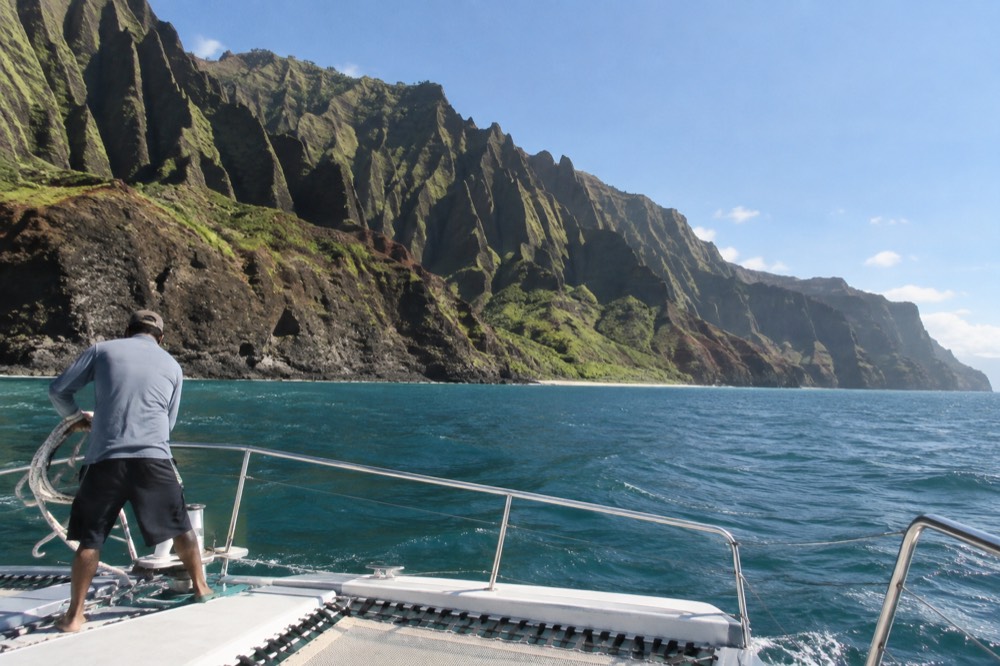
For the shoulder months, a sunset cruise like the one aboard ‘Imiloa or the Lucky Lady is a smart pick because it runs in the late afternoon when winds are dropping, and it does not require a snorkel stop. The raft snorkel tours, meanwhile, are at their best from May through September when the swell is small enough for the rigid-hull inflatables to slip inside the sea caves. A raft tour in July is about as close to a sure thing as the Napali Coast offers.
The Amelia K’s lunch-included tour is a strong all-rounder that works in nearly any month, and it carries a 4.9 from 2,050 reviews, so it is a proven pick for visitors who want a full day on the water without the bouncier ride of a raft.
Common Questions About Kauai Weather
What month has the best weather in Kauai?
July and August combine the smallest offshore swell, the most consistent trade winds, and the lowest rainfall on the west side, making them the top months for a Napali Coast boat tour. April, May, September, and October are close behind, with slightly higher swell and fewer crowds.
What is the rainiest month in Kauai?
The rainiest period runs from November through March, when winter storms and frontal passages bring heavy rain to the north and east shores. The west side, where boat tours depart, stays much drier, but the Napali cliffs catch more moisture year round.
When is hurricane season in Hawaii?
Hurricane season in the Central Pacific runs from June 1 through November 30, but direct hits on Kauai are rare. The more common disruption is the large swell and wind from distant storms, which can cancel boat tours even when the storm stays far away.
Is Kauai always windy?
The trade winds blow most days, but their strength varies. Summer trades are steady at 15 to 20 knots and ease after sunset. Winter brings stronger, gustier winds during frontal passages, with calm lulls in between. A boat tour’s route and timing are often chosen to work with the wind, not against it.
Can you swim in Kauai in the winter?
Yes, but the north-shore beaches can be dangerous due to high surf. The south and west shores, including the areas near Port Allen and Kikiaola, are generally calmer. A winter boat tour may skip snorkeling if the swell is up, but the water temperature stays around 74 to 80 °F year round.
How far in advance should I book a boat tour for the best weather?
Book as soon as your travel dates are firm, especially for July and August, because the calmest months fill first. If you are traveling in the shoulder or winter, book early in your stay so you have room to reschedule if the ocean conditions are rough on your first chosen day.