Best Time To Visit Kauai For A Boat Day On The Napali Coast
Kauai does not have a bad month so much as a set of trade-offs, and the single most useful thing a visitor can know is which months give the calmest water along the Napali Coast, because that decides which boat tours can actually run.
Short answer
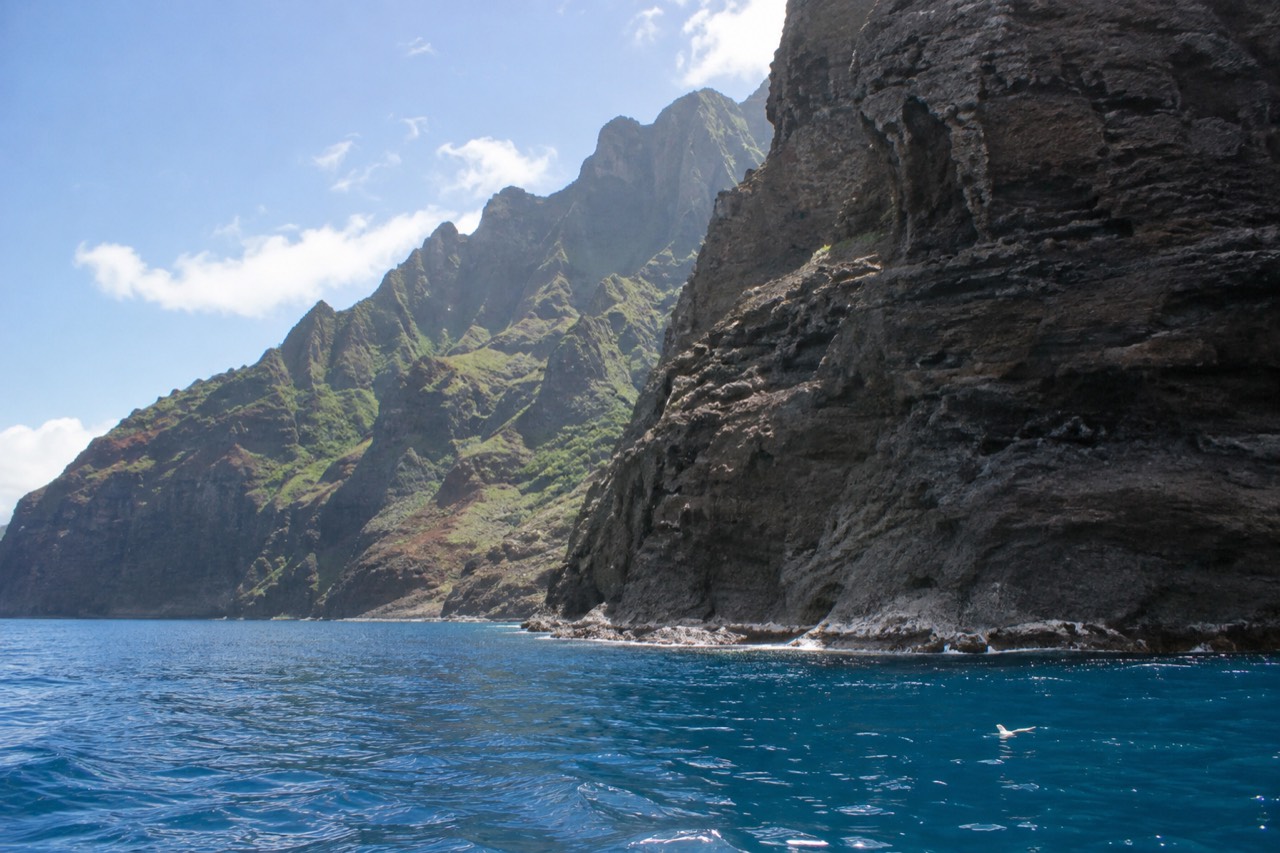
The calmest water along the Napali Coast runs May through September, when a buoy off the north shore records almost no observations above 2.5 metres. Humpback whales arrive November through April, the same months as the biggest swell. Boat tours start from $190 per person and run year round from the west side.
Choosing travel dates on Kauai is really a question about the ocean. The island's headline attraction, the Napali Coast, is a 16-mile stretch of cliffs that most people see from a boat, and whether that boat can run, reach the sea caves or stop for a snorkel depends almost entirely on the swell. Pick the right month and the water is glass; pick the wrong one and the same tour becomes a shorter, rougher, cave-free ride. This guide works through the island's seasons month by month, using measured wave data and official rainfall records rather than the usual folklore, and ends with a booking grid that matches tours to months.
What Are Kauai's Two Seasons?
Kauai has a dry, calm summer from roughly May through September and a greener, rougher winter from November through March, with April and October as the genuine shoulders. The distinction is driven by north Pacific swells, not by temperature: Lihue's January mean maximum is 78.6°F and Waimea's is 79.5°F, so the ocean, not the air, is what changes.
Temperature barely moves on Kauai. What moves is the sea state, the rainfall and the crowds. Winter brings the big north and northwest swells that make the exposed shores exciting and the boat rides bumpy. Summer brings trade winds that blow steadily, mornings that are reliably calm on the leeward coast, and the highest visitor counts of the year.
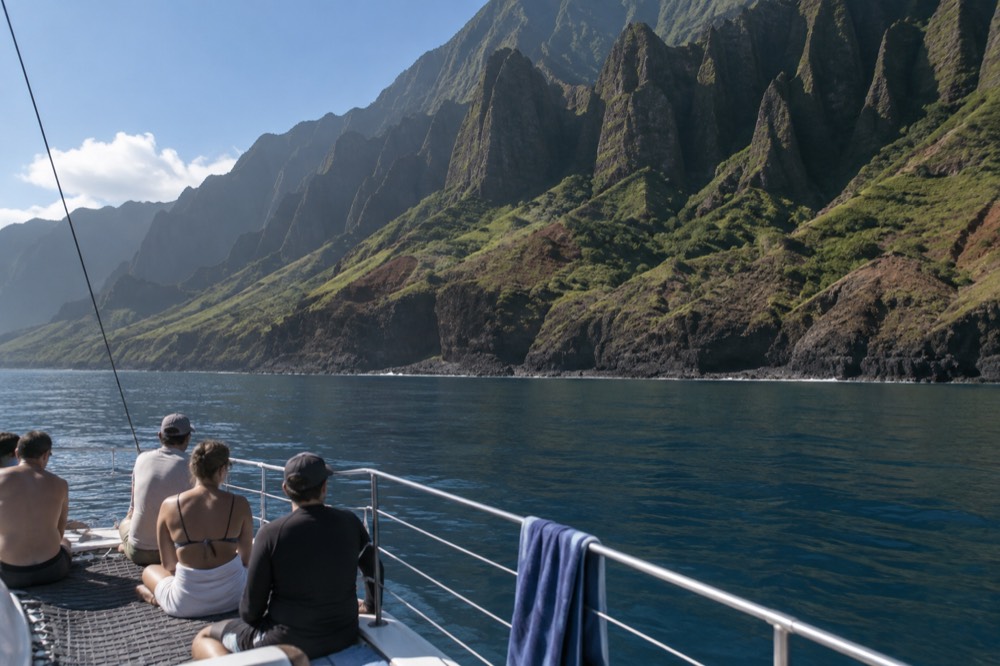
The two seasons also decide what you can do. Kayaking the coast is permitted only between 15 May and 7 September, a state rule that exists because the winter sea is genuinely unsafe for paddlers. Motor boats are not bound by those dates, but their product mix rotates: cave entries, beach landings and snorkel stops all become more likely in the calm half of the year. The planning logic is on the Napali Coast boat tour season page in full.
| Season | Months | Character | Air temperature | Ocean |
|---|---|---|---|---|
| Dry summer | May to September | Steady trades, calm leeward mornings | Warm, drier on the west side | Smallest swell, best cave and snorkel odds |
| Shoulder | April, October | Variable, quieter | Warm | Mixed swell, tours run with occasional changes |
| Wet winter | November to March | Green, dramatic, whale season | Mild, 78°F daytime highs | Largest swell, some routes shortened |
When Is The North Shore Calmest?
The north shore, Hanalei and Haena, is calmest from June through September, when the Hanalei wave buoy records almost no observations at or above 2.5 metres: 0.2 percent in June, 0.1 percent in July and September, 1.6 percent in August. January is the opposite, with 52.2 percent of observations at or above 2.5 metres and 24 percent above 3.5 metres.
These are real measured numbers, not marketing. The NOAA and PacIOOS Waverider buoy moored off Hanalei in about 200 metres of water transmits wave height every 30 minutes, and two recent years of its record reduce to a clear pattern: June through September the offshore sea essentially never gets large, while December through February it is large about half the time.
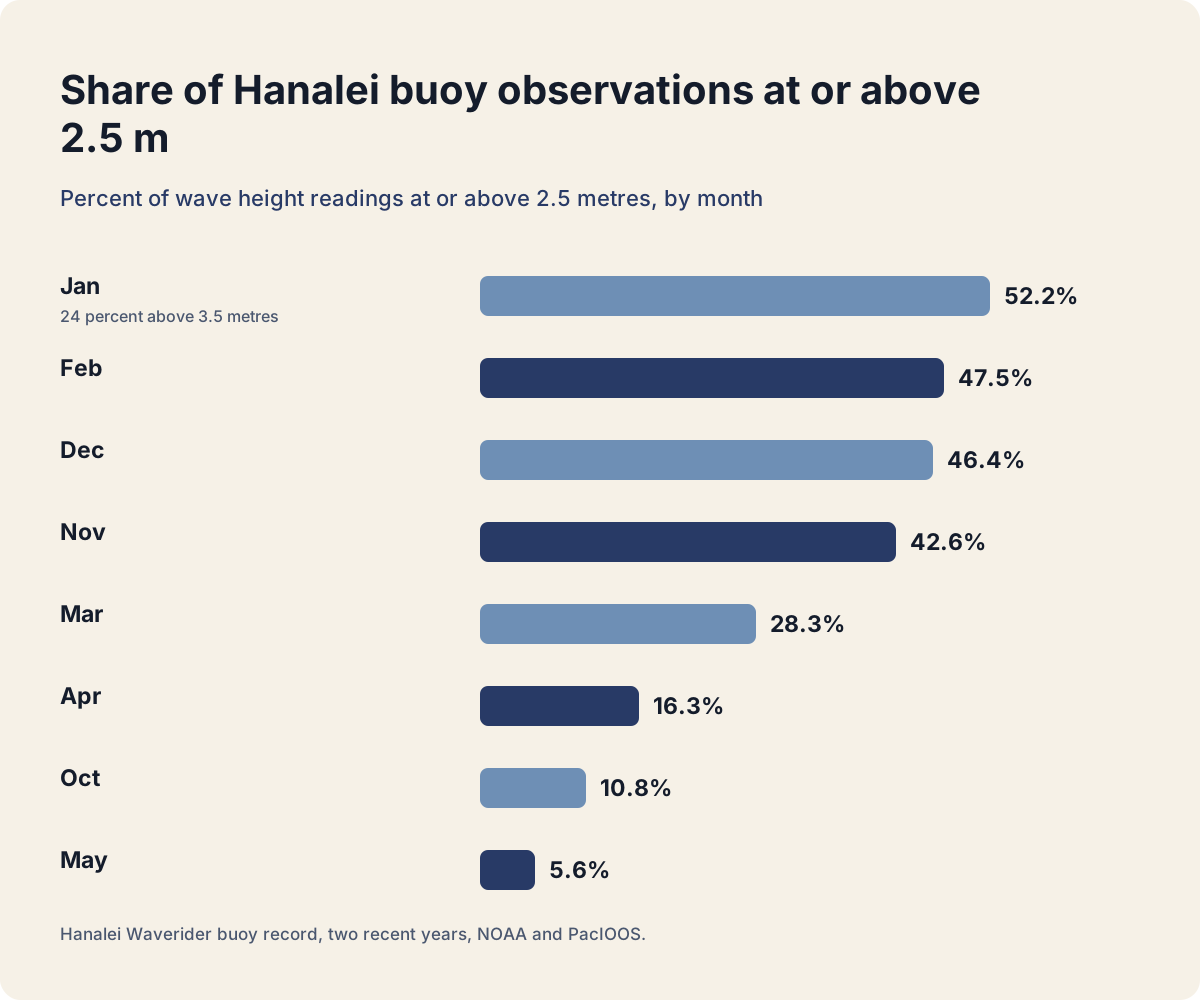
Two honest caveats travel with this data. It is two recent years, not a 30-year climatology, so it shows a pattern rather than a guarantee. And significant wave height measured offshore in deep water is not the same as breaker height at the shoreline or the ride quality on a boat; treat it as the background sea state the captains are reading.
| Month | Mean wave height | 90th percentile | Share of observations at or above 2.5 m |
|---|---|---|---|
| Jan | 2.77 m | 4.01 m | 52.2% |
| Feb | 2.47 m | 3.21 m | 47.5% |
| Mar | 2.12 m | 2.86 m | 28.3% |
| Apr | 1.93 m | 2.83 m | 16.3% |
| May | 1.73 m | 2.26 m | 5.6% |
| Jun | 1.61 m | 2.08 m | 0.2% |
| Jul | 1.50 m | 1.99 m | 0.1% |
| Aug | 1.40 m | 1.82 m | 1.6% |
| Sep | 1.42 m | 1.88 m | 0.1% |
| Oct | 1.76 m | 2.53 m | 10.8% |
| Nov | 2.42 m | 3.02 m | 42.6% |
| Dec | 2.61 m | 3.84 m | 46.4% |
The north shore matters even for visitors who never board a boat there, because the same swells that close Hanalei Bay also wrap around onto the Napali Coast's exposed northwest faces. The state's own rainfall record shows the contrast within the island: Lihue on the east side averages 36.22 inches of rain annually spread over 192.6 days, per the NOAA 1991 to 2020 climate normals, while the west side around Waimea sits in one of the driest corners of the island.
When Is The West Side Calmest?
The west side, where every Napali boat tour on this site departs, is at its calmest from May through September, and it is the only side that runs tours all year. Port Allen and Kikiaola sit on the leeward southwest shore, sheltered from the trades, so even winter departures usually find workable water, with cave entry and snorkelling most reliable in summer.
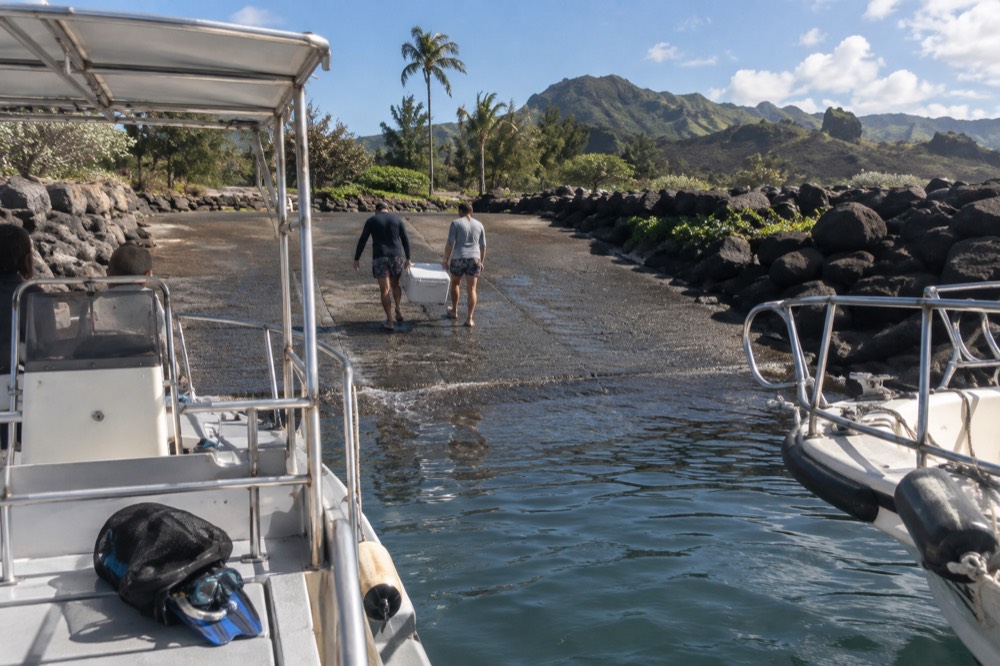
There is no harbor at Hanalei at all; boats there work off an open bay, which is exactly why north-shore operations shrink in winter. The west side has two real harbors, Port Allen at Eleele and Kikiaola near Waimea and Kekaha, and 18 of the 26 tours on this roster leave from Port Allen. That is the structural answer to the whole "when to visit" question: book a west-side departure and the calendar opens up dramatically.
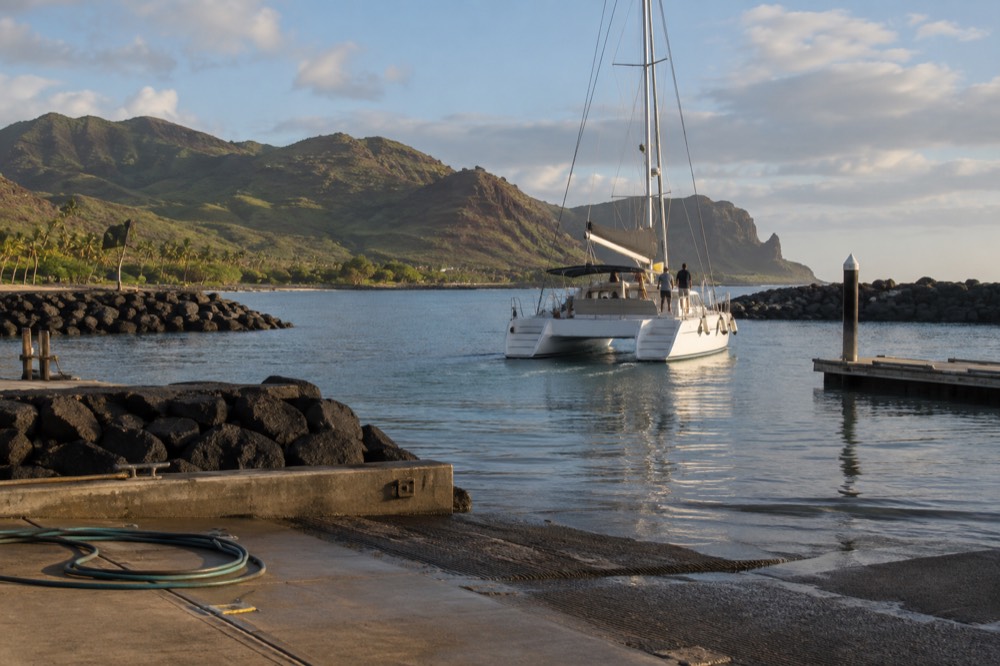
What rotates through the year is the product, not the existence of the product. In the calm half of the year, raft tours run sea-cave expeditions and snorkel stops near daily. In the rough half, the same operators lean on sunset cruises and sightseeing runs, which tolerate more swell because they do not try to put people in the water or nose into cave mouths. The Kauai Sea Tours raft snorkel tour states it plainly: it operates all year, weather permitting, 5 hours 30 minutes, breakfast included, from $217 per person, with a maximum of 14 guests and a 4.8 rating from 1656 reviews.
The three tours above span the range a date-shopper actually weighs: the express sunset trip as the year-round option, the long lunch cruise as the comfortable all-rounder, and the small-group raft as the summer specialist. If your dates fall outside summer, the sunset and sightseeing products are the safest bets, and the driving logistics are covered on the getting to Port Allen and Kikiaola page.
| West-side conditions | Best months | What runs well | What gets harder |
|---|---|---|---|
| Calm and dry | May to September | Raft cave tours, snorkel stops, beach landings | Nothing, but crowds peak |
| Shoulder | April, October | Catamaran cruises, morning snorkel runs | Afternoon wind picks up |
| Winter swell | November to March | Sunset cruises, sightseeing, whale watching | Cave entry, some snorkel stops |
What Months Bring The Whales?
Humpback whales are in Hawaiian waters from November through April, with the commercial sighting season on Kauai running December through March and the peak usually in January and February. The catch is that whale season and the big-swell season are the same months, which is why winter whale tours depart the west side and stay off the south and west shores rather than running the Napali Coast.
The sanctuary's own guidance puts the window at November through April. Operators sell a narrower commercial season: December to March, with the strongest sightings mid-winter. A February 2026 coordinated shore count across the main Hawaiian Islands logged 1,935 humpback sightings in a single day, 337 of them from Kauai stations, which tells you how dense the population gets at the peak.
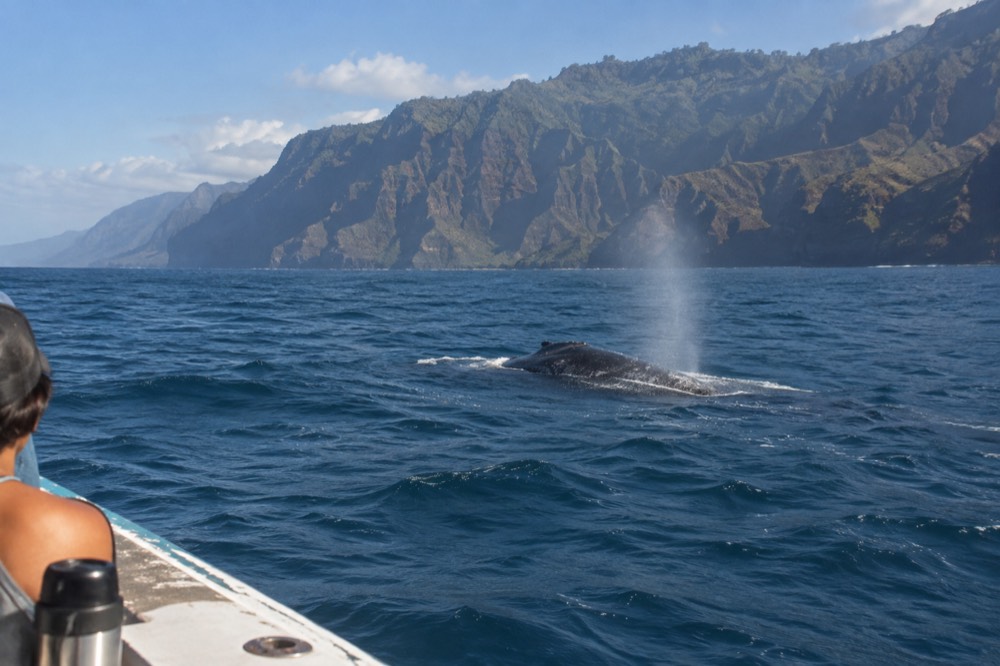
This is the one genuine conflict in Kauai's calendar. The months with the most whales are the months with the most swell, and the buoy data and the whale window overlap almost exactly. A winter visitor can absolutely see whales from a boat, but the honest version is a south or west shore whale cruise, not a full Napali run. The details, including the federal 100-yard approach rule, are on the Napali Coast whale watching page.
If your dates land in the overlap, a sunset cruise is the product that works in both worlds. The Express Na Pali Sunset Tour aboard 'Imiloa runs year round, conditions permitting, 5 hours from Port Allen with a late lunch included, from $190 per person, rated 4.5 from 224 reviews, capped at 36 guests, and free cancellation. It is the lowest entry price on the whole roster, which makes it a natural hedge for a shoulder-season trip.
| Period | Whale presence | Typical tour focus | Cave and snorkel odds |
|---|---|---|---|
| November | Arriving, scattered | Napali runs when swell allows | Dropping fast |
| December to March | Peak season | South and west shore whale cruises | Low |
| April to May | Departing | Napali runs, whales possible early on | Rising |
| June to October | Essentially absent | Full Napali, caves, snorkel | High |
When Is It Wettest?
Kauai is wettest from November through March, when winter storms and trade-wind showers stack up against the mountains, and driest from May through September. The west side, where the boat harbors sit, is dramatically drier than the east: Lihue records rain on 192.6 days a year on average, while the leeward coast around Waimea is one of the driest places on the island.
The numbers come from the official 1991 to 2020 climate normals. Lihue's January, the wet-season benchmark, averages a mean maximum of 78.6°F with 2.78 inches of rain over about 12 rain days; Waimea on the west side posts a January mean maximum of 79.5°F. The island's famous wetness is real, but it is concentrated on the windward mountains: the Rainfall Atlas of Hawaiʻi, whose mean maps use the 30-year period 1978 to 2007, shows the summit country near Mount Waialeale collecting several hundred inches a year while the leeward lowlands stay comparatively dry, per the University of Hawaiʻi rainfall atlas.
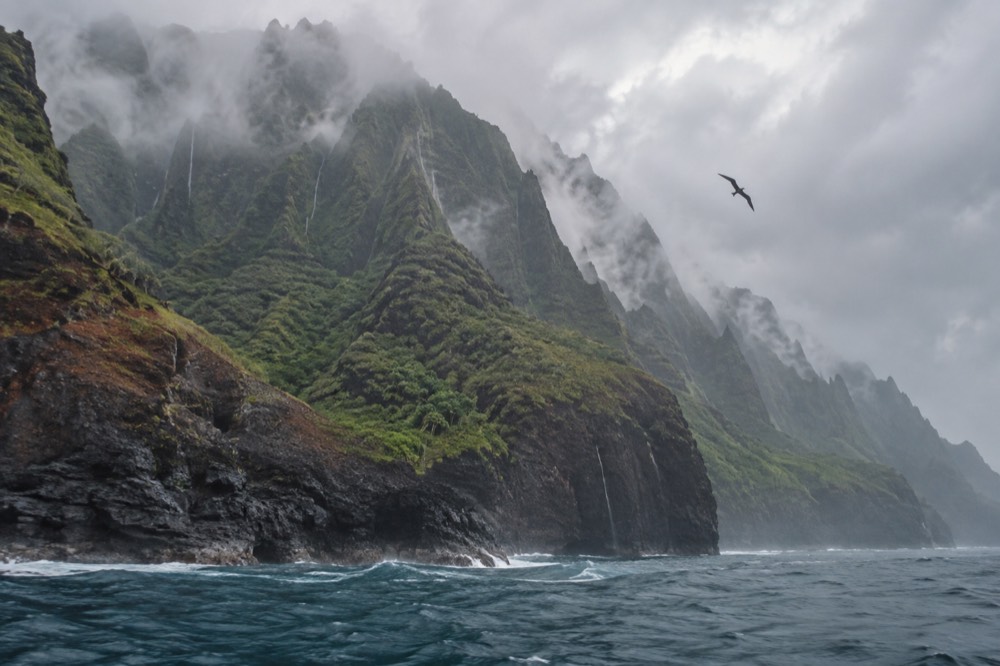
For a boat day, the practical reading is this: rain is a weak predictor of whether your tour runs. Operators on this coast say plainly that light rain does not stop a tour, and that it routinely rains on land while the water offshore stays clear. What cancels trips is wind and swell, not showers. So a wet forecast in your week matters for your hiking days, not your boat day. The wider set of guides lives on Napali Coast Boat Tours.
| Station | January mean max | Annual rainfall | Character |
|---|---|---|---|
| Lihue (east side) | 78.6°F | 36.22 inches over 192.6 rain days | Green, frequent light showers |
| Waimea (west side) | 79.5°F | One of the driest spots on the island | Sunny, boat-friendly |
One planning note for photographers: drones are banned in all Hawaii state parks, state beaches and recreation areas without written DLNR approval, so aerial footage of the coast is not something to build a trip around. The boat is the legal camera platform here.
When Are Prices And Crowds Highest?
Summer, roughly June through August, is Kauai's peak for both crowds and lodging cost, and the winter holiday stretch around late December runs a close second. Recent counts show 128,883 visitor arrivals by air in June 2026 and 139,974 in July 2026, the highest monthly figures of the year so far, while the first half of 2026 was down 8.5 percent on the same period in 2025.
The state's tourism statistics are the honest crowd gauge. Midsummer is when the daily visitor census peaks at over 28,000 people on an island of about 73,000 residents, and that pressure lands directly on boat seats: the small-group raft tours, capped at 14 guests, sell out furthest ahead in July and August. The 2026 softening is real but modest, and it has not made summer bookings easy.
The island's tax stack compounds in peak season because lodging rates rise underneath it. Hawaii's transient accommodations tax rose to 11 percent from 1 January 2026, and Kauai County adds its own 3 percent on top, per the state tax announcement. Rental cars carry a separate surcharge of $7.50 per day. None of this touches the tour prices themselves, which on this roster run from $190 to $361.31 per person, but it shapes the total cost of the week.
The shoulder months are the value window. May and late September combine near-summer sea conditions with measurably thinner crowds, and April and October sit one notch rougher but cheaper still. The trade-off is simple: the rougher the month, the more likely your first-choice tour gets adjusted on the day, which is why every operator offers free rescheduling and why booking early in your stay matters.
| Period | Visitor pressure | Boat seats | Value verdict |
|---|---|---|---|
| June to August | Highest, 28,000+ daily census | Tightest, book far ahead | Best water, worst crowds |
| Late December | Holiday spike | Tight around holidays | Good whales, busy |
| May, September | Moderate | Comfortable | Best overall balance |
| April, October | Lower | Easy | Cheaper, more weather risk |
Which Month Should You Aim For?
For a trip built around a Napali boat day, aim for May through September, with July as the single best month for water conditions and May or September as the best trade of calm seas against crowds. For whales, aim for January or February and accept a south or west shore cruise. For value, the shoulders win; for a first visit with mixed plans, late May is the strongest single answer.
Every month is defensible, so the honest way to answer is by priority. If the boat day is the point of the trip, and for most first-time visitors it is, then the sea-state data does the deciding: July's mean wave height of 1.50 metres and near-zero rough observations cannot be beaten. If you are combining the boat with hiking, whale watching and fewer people, the calculus shifts.
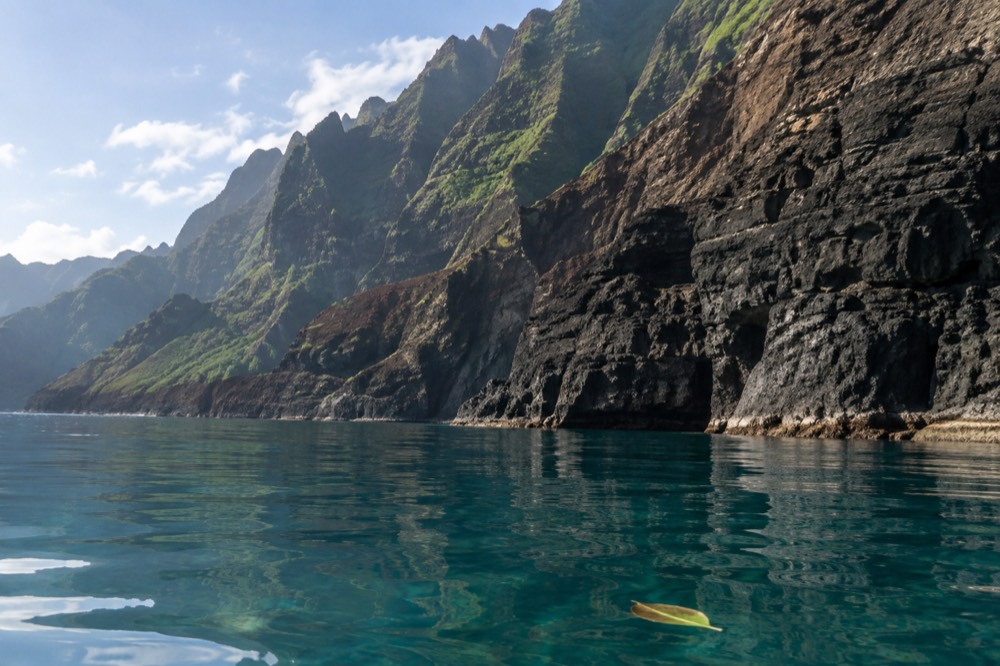
The 5-hour Amelia K tour out of Port Allen is a good anchor for a peak-summer plan: a power catamaran with lunch included, snorkelling and sea caves when conditions allow, free cancellation, from $227.13 per person, and a 4.9 rating from 2050 reviews, one of the deepest review pools on the roster. In July, book it weeks ahead; in May, days ahead is usually enough.
A useful trick for rougher months: book your boat day for the front of your stay, not the back. Operators hold rebooking priority for guests who still have days left on the island, so an early tour date leaves room to retry if the swell forces a change. The morning-versus-afternoon question has its own answer on the best time of day for a boat tour page.
What Should You Book For Your Month?
Match the tour to the month's sea state: rafts and snorkel-heavy tours for June through September, catamaran cruises for the shoulders, and sunset or whale-focused trips for winter. Every tour on this roster carries free cancellation, so the right move is to book the summer-style tour early and rebook rather than waiting on a forecast that only becomes reliable days out.
The grid below is the whole article compressed. Find your month, book the tour type that fits, and hold the free cancellation as your insurance policy. Prices are the current starting figures from each operator's live listing.
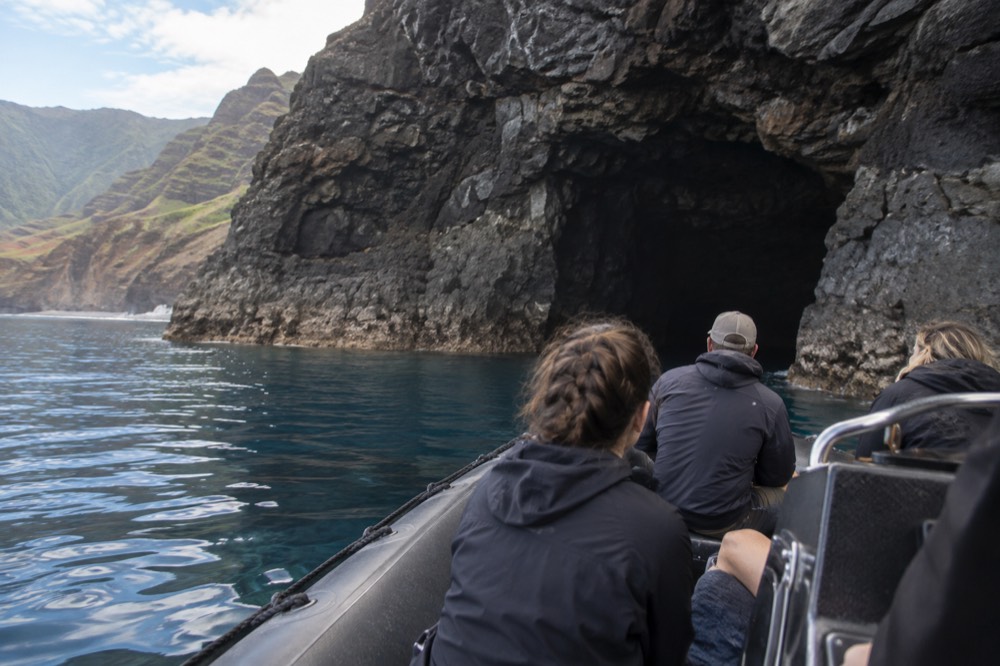
The raft snorkel tour is the summer pick: 5 hours 30 minutes from Port Allen, breakfast included, maximum 14 guests, from $217 per person, rated 4.8 from 1656 reviews. Its small size is what gets it into the sea caves, and the cave mouths are what need the calmest water, so this is the tour that most rewards a July or August date.
| Your month | Book this | Why | Watch for |
|---|---|---|---|
| January, February | Sunset cruise or whale cruise | Whales peak, Napali swell peaks | Book boat day early in your stay |
| March, April | Catamaran cruise with lunch | Swell easing, whales leaving | Afternoon wind |
| May | Full-day snorkel raft or catamaran | Near-summer water, thinner crowds | Nothing much |
| June to August | Raft cave and snorkel tour | Best cave and snorkel odds of the year | Sell-outs; book weeks ahead |
| September, October | Morning snorkel, afternoon sunset | Calm mornings persist, crowds drop | Late-season swells from October |
| November, December | Sunset dinner cruise | Shortest days, dramatic light | Early sunset times shift schedules |
For any month, the Express Na Pali Sunset Tour aboard 'Imiloa is the flexible default: 5 hours from Port Allen, late lunch included, from $190 per person, rated 4.5 from 224 reviews, capped at 36 guests, free cancellation, and running year round when conditions allow. Winter visitors should pair it with a whale cruise; summer visitors can pair it with a morning raft and get both halves of the coast in one day.
Common Questions About The Best Time To Visit Kauai
What is the best month to visit Kauai for a Napali Coast boat tour?
July is the best single month for water conditions, with a measured mean wave height of 1.50 metres off the north shore and virtually no rough observations. May and September are close behind with far fewer crowds, making them the best overall trade for most visitors.
Is there a bad time to visit Kauai?
No month is impossible, but November through March brings the largest swell and the highest chance of a tour being adjusted or rerouted. If your whole trip hinges on the boat day, that window carries the most risk; the guide to when not to go to Kauai covers the exceptions.
Do Napali Coast boat tours run year round?
Yes, from the west side. Tours depart Port Allen and Kikiaola all year, conditions permitting; the 15 May to 7 September dates often quoted are the kayak and Milolii landing rules, not a boat season. What changes in winter is the product mix, not the existence of tours.
Can you see whales and have calm seas in the same month?
Only at the edges. The whale window, November through April, overlaps almost exactly with the big-swell months. April and late November occasionally deliver both, but the reliable combination does not exist; winter whale tours deliberately stay off the south and west shores.
When is Kauai cheapest to visit?
The shoulder months, April, May, September and October, combine lower lodging rates with easier boat availability. Tour prices themselves hold steady year round on this roster, from $190 to $361.31 per person, so the savings come from accommodation and crowds rather than tickets.
How far ahead should you book a Kauai boat tour?
In June through August, book small-group tours several weeks ahead. In the shoulders, a week is usually enough. In any month, place your boat day early in your stay so a weather reschedule still fits your trip, and rely on the free cancellation every tour here carries.