What Color Not To Wear When Snorkeling In Kauai?
The honest answer on snorkel colors for Kauai waters: what the yellow myth gets wrong, what crews actually say, and what to pack for a Napali Coast boat tour.
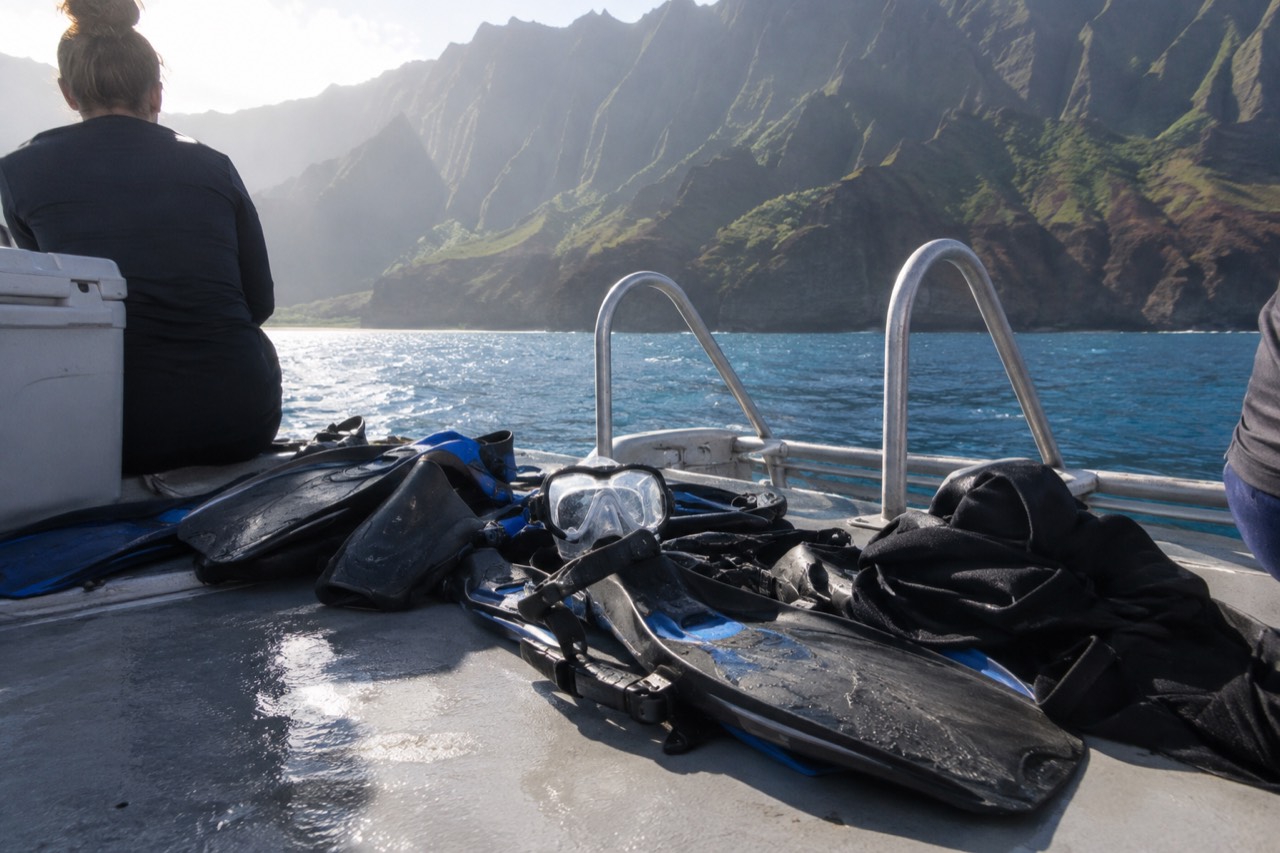
Snorkel color advice is one of the most confidently repeated pieces of travel lore in Hawaii, and almost none of it survives contact with the evidence. The short version: bright yellows and high-contrast patterns get flagged in every packing list, but the reasons usually given are either unproven shark lore or a misreading of what marine animals can actually see. What genuinely matters on a Kauai snorkel tour is sun protection, fit, and staying inside the rules that protect the animals you came to watch.
This page answers the question for the specific situation most readers are in: a boat-based snorkel stop on the Napali Coast, where the water is warm, the sun is direct, and the crew hands you fins on the swim step. The color question is real, but it sits inside a bigger packing decision.
What Colors Should You Not Wear Snorkeling?
Skip bright yellow, high-contrast black-and-white blocks, and anything that flashes like a wounded reef fish, and prioritize dark or muted blues, greens, and grays with full upper-body coverage. The honest caveat: no peer-reviewed study shows a snorkel outfit color causing a dangerous encounter, so treat color as a low-stakes preference layered on top of the decisions that actually matter, which are coverage, fit, and sun protection.
The color question comes in two flavors, and they get confused constantly. The first is the shark-visibility argument: that certain colors attract attention from large marine predators. The second is the practical argument: that certain colors help or hinder your experience, your visibility to the boat crew, and your photographs. The first is mostly folklore with a thin scientific veneer. The second is real and worth ten minutes of thought before you pack.
Here is the standard guidance, with honest confidence labels on each row:
| Color or pattern | Common advice | How solid is it |
|---|---|---|
| Bright yellow | Often called "yum yum yellow" in dive lore; said to resemble fish prey | Lore, not evidence. No controlled study ties yellow swimwear to shark approaches |
| High-contrast black and white blocks | Said to mimic the silhouette of a seal or prey item | Speculative. Sharks discriminate contrast, but no study links swimwear patterns to bites |
| Bright orange or red | Sometimes flagged, sometimes recommended for crew visibility | Contradictory advice; red also reads as gray below a few meters of water |
| Muted blue, green, gray | Blends with the water column; the usual "safe" recommendation | Reasonable and harmless, but it is a preference, not a protection |
| Dark full-coverage rash guard | Recommended by crews for sun, stings, and buoyancy comfort | Strong practical case, unrelated to predators |
Notice what that table actually says. The colors with the strongest reputation for danger have the weakest evidence, and the garment with the strongest evidence, a dark long-sleeve rash guard, is recommended for reasons that have nothing to do with sharks. That inversion is the honest heart of this question, and most packing lists miss it because they copy each other.
If you are booked on a Kauai raft or catamaran snorkel tour and want to see how the formats differ, these three cover the range from a fast rigid raft to a stable power catamaran:
Why Does Yellow Get Singled Out?
Yellow gets singled out because of a decades-old piece of dive-industry folklore nicknamed "yum yum yellow," built on the observation that some shark fishing lures and dive gear in yellow get investigated by curious sharks. It was popularized by anecdote and merchandising, not by research, and no controlled study has ever connected yellow swimwear on a snorkeler to an elevated attack risk.
The story has a specific shape, and knowing the shape helps you judge it. Spearfishermen noticed that sharks sometimes investigate bright gear. Dive shops repeated it. Guidebooks turned it into a rule. Somewhere along the way, "sharks may be curious about yellow objects" hardened into "yellow bathing suits attract sharks," which is a different and much stronger claim. Curiosity about an object is not attraction to a person, and investigation is not attack.
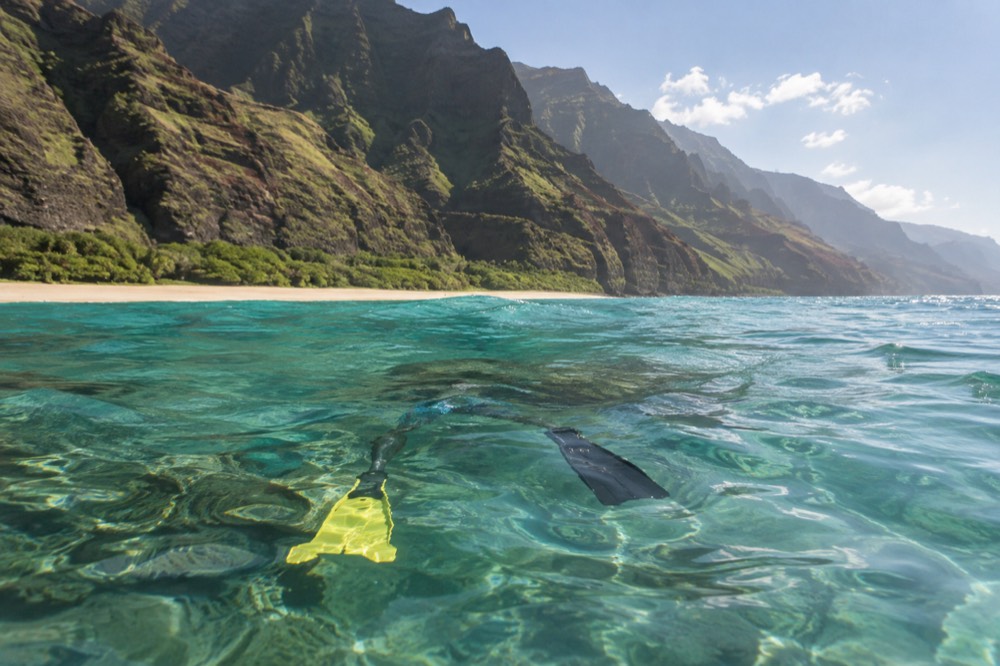
There is also a color-vision fact that cuts against the myth. Water absorbs red within the first few meters and progressively flattens the spectrum as you descend, so much of what looks vividly yellow at the surface reads as a muted tone to anything viewing you from below through several meters of water. The dramatic color you are worried about largely stops existing at the depth where the animals you are worried about actually swim.
For perspective on the real risk: sharks are a routine, unremarkable presence around Kauai reefs, and the encounters snorkelers actually have are almost always reef sharks at a distance, which is a very different picture from the folklore. If that question is on your mind, the honest breakdown of how common shark sightings really are on Kauai snorkel stops is covered in are there sharks while snorkeling in Kauai, and it is far more reassuring than the color discussion implies.
What Does The Evidence Actually Say?
The evidence says color is a minor factor in snorkel safety, and the factors that measurably matter are swimmer fitness, ocean conditions, supervision, and behavior around wildlife. Hawaii Department of Health data for 2019 to 2023 show 91% of snorkeling drowning victims were visitors, and ocean drownings accounted for 83% of all drownings statewide, which points squarely at preparation and conditions rather than wardrobe.
That drowning statistic deserves a moment, because it reframes the entire packing conversation. The people who get hurt snorkeling in Hawaii are overwhelmingly visitors, and the mechanism is exhaustion, panic, and pre-existing health factors in open water, not anything they wore. A bright yellow rash guard worn by a rested swimmer beside a crewed boat is safer than a perfectly camouflaged swimmer pushing fatigue in a current. Color is the wrong dial to turn if safety is the goal.
The regulatory layer is also about behavior, not color. Under Hawaii law it is unlawful to molest, kill, capture or possess a Hawaiian monk seal at any time, and the state recommends viewing distances of 50 feet for seals and 150 feet for mothers with pups, per the Hawaii DLNR Division of Aquatic Resources. Green sea turtles carry the same protected status with no open season. None of those rules care what color your swimsuit is, and all of them matter more.
There is one piece of gear law that does touch your outfit. Hawaii Act 104 prohibits the sale or distribution of sunscreens containing oxybenzone or octinoxate without a prescription, effective January 1, 2021, and no Kauai County ordinance exists, so the statewide rule applies on this island. Whatever you wear, the lotion you put on exposed skin has a legal floor.
What Do Kauai Crews Recommend?
Kauai boat crews overwhelmingly recommend a dark, long-sleeve rash guard over color-matching swimwear, because it blocks sun for the hour you float face-up, protects against stings and scrapes, and removes the sunscreen problem entirely for most of your skin. When crews mention color at all, it is usually to suggest avoiding anything that makes you hard to spot, not hard to find attractive.
The practical logic is easy to miss from shore. A snorkeler floats motionless, face down, for 30 to 60 minutes in direct tropical sun, often between roughly 9 a.m. and 2 p.m. when tours run their stops. That is a severe sun exposure pattern, and shoulders and the back of the legs are exactly where sunscreen wears off fastest in salt water. A rash guard solves the problem structurally. Operators on this coast typically provide masks, fins and snorkels, and some provide float belts or noodles, but shirts are almost always your own gear to bring.
On the specific tours this site covers, the format shapes the advice. The Na Pali Super Raft Snorkel Adventure from Captain J's runs 4 hours 30 minutes from Port Allen, rated 4.8 from 1,723 reviews, from $235 per person with snacks included and free cancellation. A rigid raft means a fast, exposed, occasionally wet ride between stops, so a snug dark rash guard and board shorts with a drawstring do double duty on the run out and in the water.
If you want the deeper comparison of how raft and catamaran snorkel formats differ on this coast, including who each one suits, the Napali Coast snorkel tour guide breaks down the tradeoffs by boat type, price and stop style.
What About Sun Protection Colors?
For sun protection, darker and denser fabrics block more ultraviolet radiation than lighter ones, so a black or navy rash guard outperforms a pale yellow one, which is the one place where the "avoid yellow" advice happens to be correct, for a completely different reason than the myth claims. Coverage beats color, and a UPF-rated long-sleeve shirt in any dark shade beats a white T-shirt in every measurable way.
A fabric's sun protection depends on weave density, weight, color depth and whether it is stretched wet against your skin. A loose white cotton T-shirt can drop to a fraction of its dry protection when soaked, which is exactly the condition it will be in. A snug, dark, synthetic rash guard holds its protection in salt water, dries fast, and does not billow up around you while you swim. If you own a UPF 50 rated surf shirt, that is the single best item on this entire packing list.
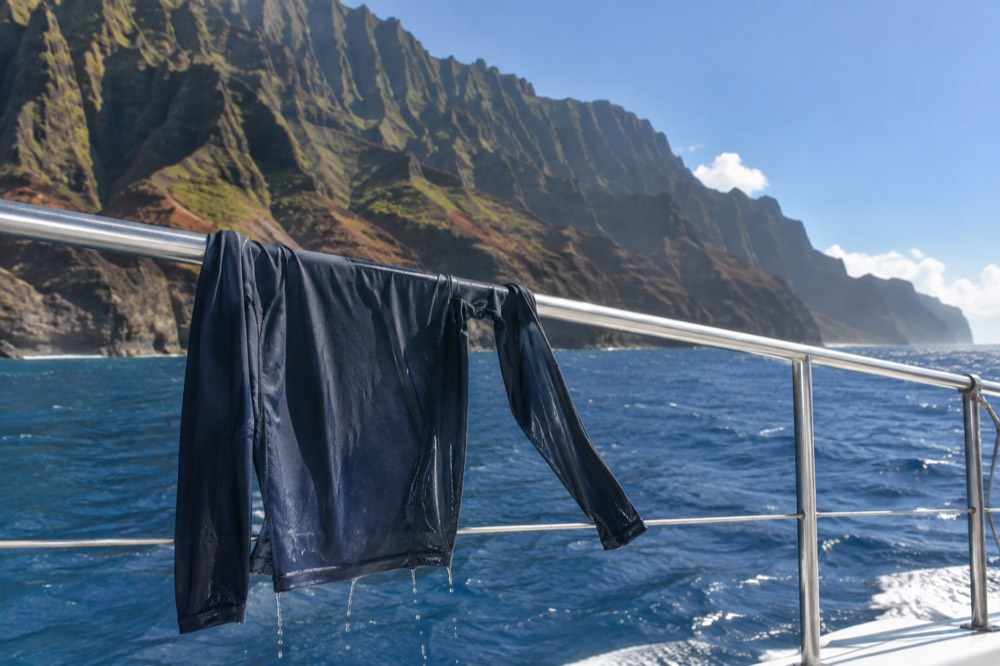
The color hierarchy for sun, as opposed to the color hierarchy for sharks, runs in the opposite direction from the folklore. Black absorbs the most visible light and also attenuates more UV through the fabric. Pale yellow sits near the bottom of the sun-protection table while sitting at the top of the mythical danger table. So if you want a rule of thumb that survives both arguments: wear dark, snug, full-coverage fabric, and you have satisfied the sun science while incidentally satisfying the shark superstition.
For exposed skin, remember the state law on reef-hostile chemicals from earlier: oxybenzone and octinoxate sunscreens cannot be sold in Hawaii without a prescription, so a mineral zinc or titanium dioxide formula is both the legal retail standard on island and the reef-friendly choice at the snorkel stop. Apply it before boarding, reapply at the boat, and let the shirt handle the rest.
Does It Matter On A Boat Tour?
On a crewed Kauai boat tour, color matters least of all, because the crew tracks you, the boat anchors a defined snorkel site, and a spotter stays on deck while you are in the water. The choices that matter on the boat are wearing something that stays put during a wet boarding, keeping your shirt on for the ride, and following the crew's instructions on where to swim.
A boat-based snorkel stop is a supervised, bounded swim, not a free dive off a lonely beach. The stop runs at a location the captain picks that morning for conditions, typically for 30 to 60 minutes in the water, with the vessel at anchor and crew watching. State rules require the diver's flag and the 100-foot distances around it, per the state boating division's snorkeling rules, and commercial crews run their stops inside that framework. In that setting, whether your fins are yellow is roughly the last variable in your safety equation.
What actually changes your day on the boat is fit and behavior. Raft tours board over a hull that can be wet and moving, and loose hats, dangling straps and unsecured sunglasses go overboard regularly. Snug gear survives the ride. On the water, the rules that protect the animals are the ones to keep: keep your distance from seals and turtles, do not touch or chase anything, and skip the fish feeding, which is discouraged in Hawaii's marine conservation areas because it disrupts natural diets.
For a stable-format alternative, the Na Pali Coast Power Catamaran from Na Pali Experience runs 4 hours 30 minutes from Kikiaola near Waimea, rated 5.0 from 811 reviews, from $274.93 per person with snacks included and free cancellation. A catamaran's wide swim step and steadier deck suit swimmers who want the water entry to be the least dramatic part of the day, and the same dark-shirt advice applies identically.
If you are still weighing which boat format suits your group, the raft versus catamaran comparison for the Napali Coast covers how the two experiences differ, and the operator pages on Napali Coast Boat Tours list every tour with its departure harbor, duration and inclusions side by side.
What Should You Pack Instead?
Pack a dark long-sleeve UPF rash guard, board shorts with a secure closure, reef-safe mineral sunscreen, a strap for your sunglasses, a towel, and a change of dry clothes for the ride back, and skip anything loose, dangling or precious. Everything on this list survives salt water, wind and a wet deck, and none of it depends on shark color theory.
The list is short because the boats provide the rest. Masks, fins and snorkels come with the tour. Some operators add flotation and some include food, so check your specific tour's inclusions before adding much beyond the personal layer. Here is the packing table, sorted by how much each item actually earns its place:
| Item | Why it earns its place | Priority |
|---|---|---|
| Dark long-sleeve UPF rash guard | Sun block for the whole float, sting and scrape protection, no sunscreen needed on covered skin | Top |
| Board shorts with drawstring or waistband | Stays on during raft boarding and swimming | Top |
| Mineral sunscreen, zinc or titanium dioxide | Legal retail standard in Hawaii, reef-friendly at the stop | Top |
| Secure sunglasses strap | Kauai runs open-deck boats; unstrapped eyewear goes over the side | High |
| Towel and dry layer for the return ride | The ride back is windy and you will be wet | High |
| Water shoes or secure sandals with grip | Harbor docks and swim steps are wet and uneven | Medium |
| Motion sickness remedy taken before boarding | Cheaper than losing the day; see the seasickness advice below | Medium |
That last row deserves its own sentence. If swell sensitivity runs in your group, the question of whether seasickness is common on these boats, and what actually prevents it, is answered in detail in will you get seasick on a Napali boat tour, and reading it before you book beats reading it at the dock.
What Else Goes In The Dry Bag?
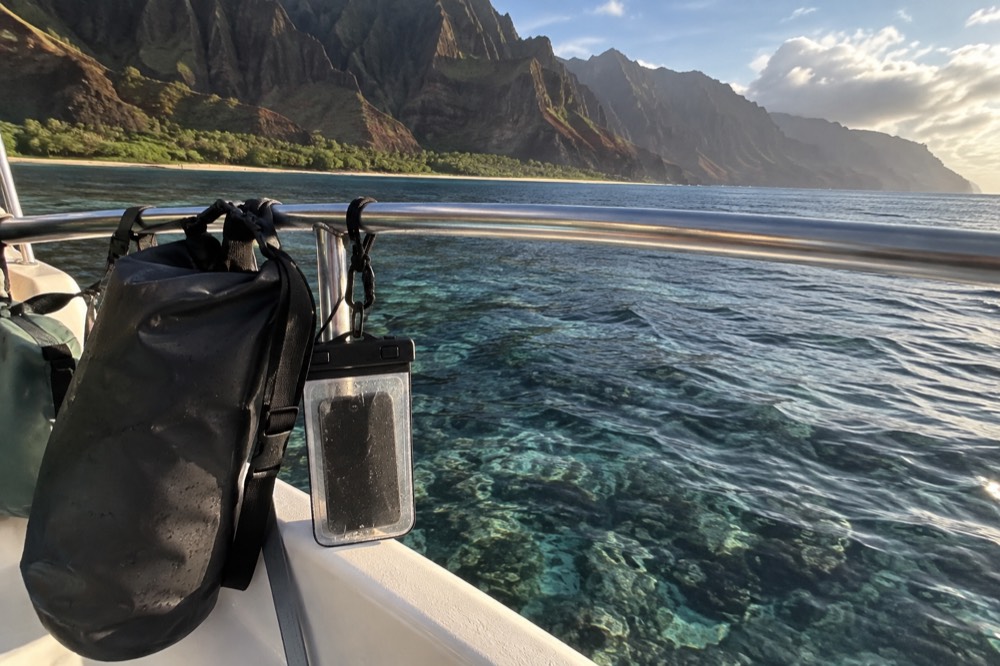
A dry bag belongs on any Kauai boat day, and what goes in it is the small, expensive, water-vulnerable set: phone in a waterproof case, a spare battery, medication, keys, one card and ID, and the dry clothes you want waiting for you. Leave the towel accessible, keep the sunscreen out where you will reapply it, and leave anything you cannot afford to lose at your accommodation.
The phone question deserves honesty. Salt spray and boarding splashes kill phones on these tours every week, and a waterproof pouch rated for immersion is the only real protection. A dry bag alone protects against spray and rain, not against a phone that goes into the water off the swim step, because a dry bag that is open at that moment protects nothing. If underwater photos are the goal, a pouch with a lanyard worn against the body is the standard answer.
Two Kauai-specific notes finish the bag. First, there is no shop at the snorkel stop: whatever you want at the stop, from sunscreen to water, travels on the boat with you, and most tours supply drinks and food as part of the ticket, so check your tour's inclusions rather than packing a cooler. Second, if your tour departs from Kikiaola near Waimea rather than Port Allen, note that parking there is paid and managed by a third party, while Port Allen's lot is free and first-come, which is a planning detail worth settling the night before an early departure. The getting to Port Allen and Kikiaola guide covers both harbors, drive times and check-in logistics.
One last color note, because it loops back to where this started. If you want to be easy for the crew to spot in the water, a bright accent on your fins or a colored swim buoy does that job without any of the mythical downsides attributed to swimwear. Visibility to your own boat is the one color decision with a real, immediate payoff, and it is the one nobody warns you about.
If the packing is settled and the only remaining question is which trip to book, these three snorkel-capable tours cover the range of formats and prices on this coast:
Common Questions About Snorkel Colors In Kauai
What Color Not To Wear When Snorkeling?
Avoid bright yellow and high-contrast black-and-white blocks if the folklore bothers you, but the honest answer is that no evidence ties swimwear color to danger. What you should genuinely not wear is anything loose, anything without sun coverage, and any sunscreen containing oxybenzone or octinoxate, which Hawaii law restricts. A dark, snug, long-sleeve rash guard satisfies every real concern at once.
Does yellow really attract sharks?
No study supports it. The idea traces to dive-industry anecdote about sharks investigating bright objects, and it was repeated until it sounded like research. Sharks around Kauai reefs are a routine, low-drama presence, and the encounters snorkelers actually have are almost always distant reef sharks. Preparation, not color, is what keeps snorkelers safe.
What is the best color to wear for sun protection while snorkeling?
Darker, denser fabrics block more UV than pale ones, so black or navy is the practical answer. A UPF-rated long-sleeve rash guard in any dark shade outperforms a white cotton T-shirt, which loses much of its protection when wet. Coverage and fabric quality matter far more than the specific hue.
Do Kauai boat tours provide snorkel gear?
Yes. Every tour on this site's roster includes masks, fins and snorkels, and several include food, from snacks to full breakfast and lunch depending on the tour. Check the specific tour's inclusions on its listing before packing anything beyond your personal layer.
Is reef-safe sunscreen required on Kauai?
Hawaii Act 104 prohibits the sale or distribution of sunscreens containing oxybenzone or octinoxate without a prescription, effective January 1, 2021, and there is no separate Kauai County rule. Mineral sunscreens with zinc oxide or titanium dioxide are the standard on island and the right choice at the snorkel stop.
What should I definitely not bring on a Napali snorkel tour?
Leave behind anything loose and precious: unstrapped sunglasses, expensive jewelry, single-use plastics that blow overboard, and drones, which are prohibited from launch or landing in Hawaii state parks without written approval. Bring only what survives salt water, wind and a wet deck.