What Is The Best Way To See The Napali Coast?
Boat, helicopter, hike or lookout: an honest comparison of every way to see the Napali Coast, with real prices, seasons and what each one actually shows you.
What Is The Best Way To See The Napali Coast?
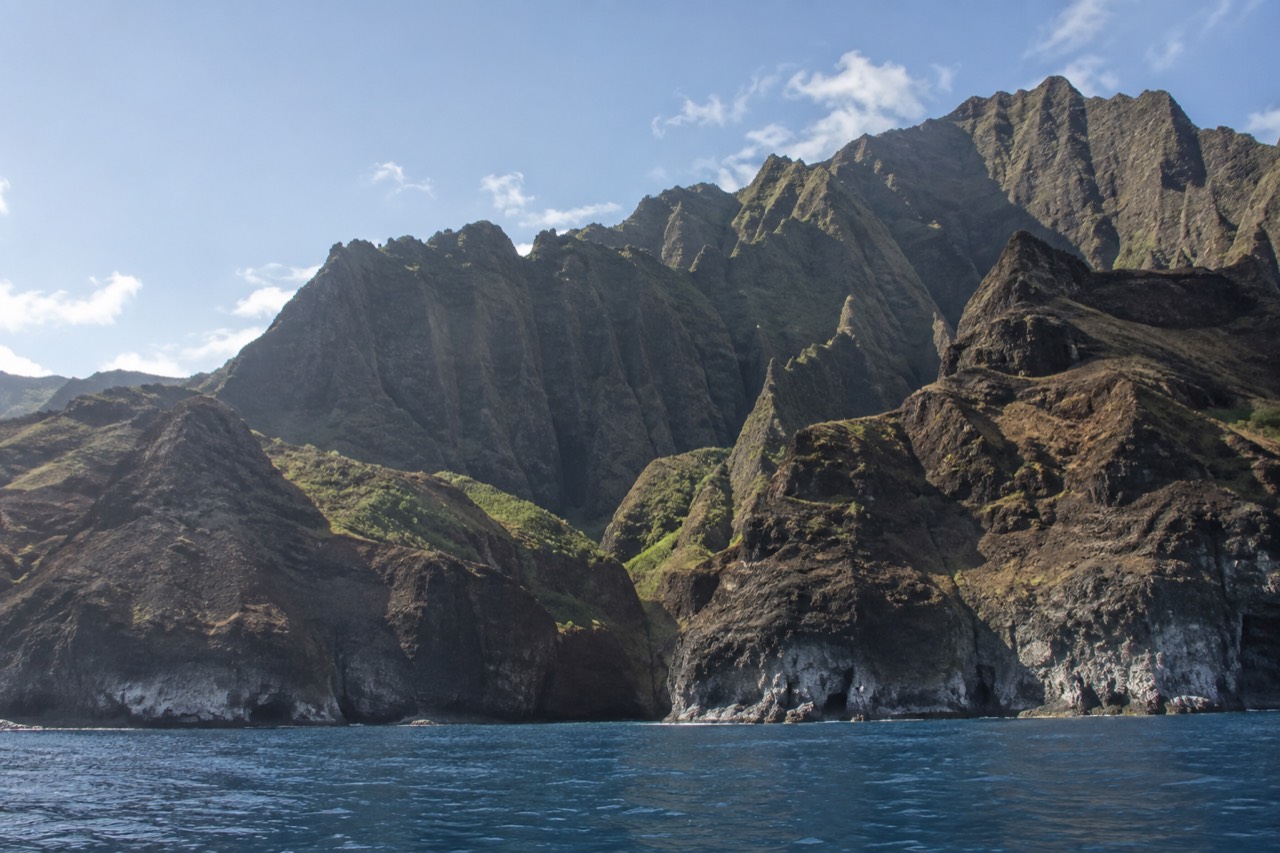
The Napali Coast is a 16-mile stretch of northwest Kauai with no road through it, and that single fact shapes every decision about how to see it. The state counts the wilderness park at 6,175 acres of valleys, sea cliffs and archaeological terraces, and the only practical ways in are by water, by air, on foot along the Kalalau Trail, or from a lookout on the far side of a canyon. Most visitors who weigh all four end up on a boat, and for good reason: the boat is the only option that puts you under the cliffs, inside the sea caves when the swell allows, and over a reef with a snorkel in your hand, all in one morning.
What Is The Best Way To See The Napali Coast?
For most visitors the best way to see the Napali Coast is a boat tour from the west side of Kauai, and the best boat for the full experience is a rigid-hull raft. A raft gets you along the base of the cliffs and, when conditions permit, inside sea caves that catamarans are too large to enter. Book a morning departure early in your stay so there is room to rebook if the ocean has other plans.
The honest hierarchy is simple. A boat is the only way to experience the coast at eye level, close enough to see waterfalls hitting the water and stone terraces cut centuries ago. A helicopter shows you the scale, the valleys and the back of the range, but it is a flypast measured in minutes and it never gets close to the sea. The Kalalau Trail shows you the coast at walking pace, two valleys of it on a day hike, in exchange for a full day of effort and a reservation system that sells out. A lookout shows you a slice of the coast for the price of a drive.
There is a reason this site exists, and it is not just commerce. Every option has a real trade-off and the boat wins on more of them than anything else: cost per hour of coastline, access in more months of the year, and the only chance at the caves and the reefs. The rest of this article compares all four honestly, because the right answer for a family with young kids is not the right answer for two fit hikers, and neither is the right answer for someone who wants photographs from above.
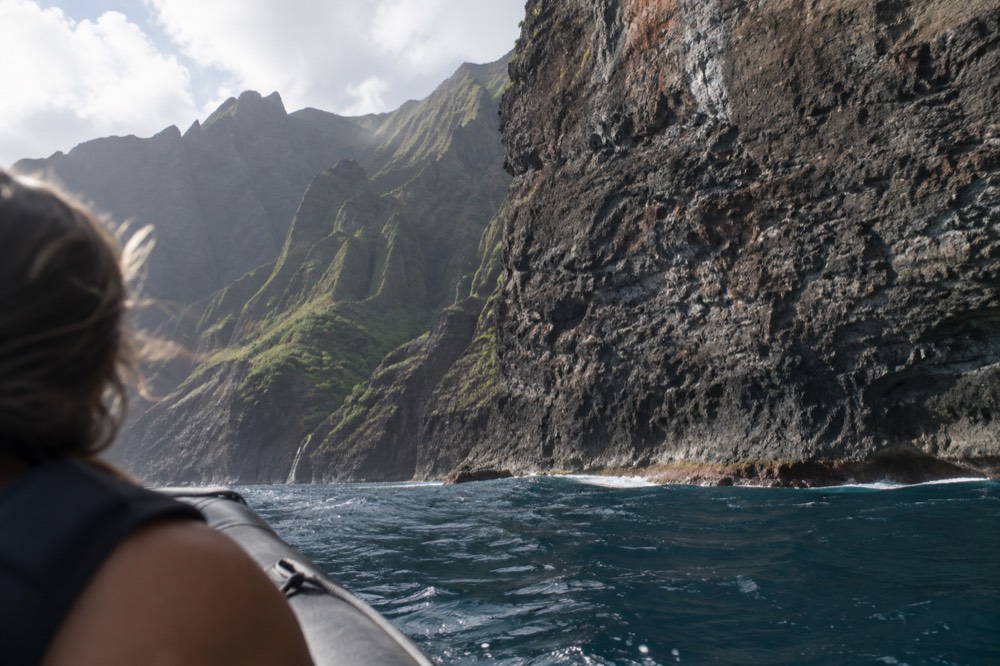
Within boats there is a second decision, and it matters more than most first-timers expect. A power catamaran is stable, spacious and carries a galley, which is why the 5-hour Amelia K tour from Makana Charters, from $227.13 per person and rated 4.9 from 2,050 reviews, is such an easy recommendation for families. A rigid-hull raft is smaller, faster, wetter and the only vessel type that reliably enters the sea caves, which is why the Zodiac products out of Kikiaola hold their own against boats twice their size. If the caves are the point of the trip, the raft is the boat.
Three tours frame the spread of what a boat day can look like:
Each of those three answers a different version of the question. The Zodiac raft expedition is the short, intense cave run. The raft snorkel tour is the long, full-coast morning with breakfast and a small group of at most 14 guests. The express sunset trip is the evening version for anyone whose mornings are spoken for. Between them they cover the price band from $190 to $235 per person, which is where most of the roster lives.
What Can You See From The Water?
From the water you see the cliffs from their base, sea caves when the swell allows entry, waterfalls, green valleys opening onto the sea, ancient stone terraces at Nu'alolo Kai, spinner dolphins in the channel, and reefs you can snorkel over. No other viewpoint gets you any of that at eye level, and the caves are reachable only by raft or a small power catamaran.
The coast rewards closeness more than anything else. From a boat the cliffs stop being a postcard and become a wall of wet stone going straight up, with goats on ledges and water threading down the rock. Operators describe the sea caves as old lava tubes widened by wave erosion, some with collapsed ceilings that let daylight in and let freshwater cascade onto the boat. That last detail is real: on raft tours with cave access, passengers get wet, and most of them are laughing when they do.
What you see depends partly on which boat you pick, and the differences are not subtle. Large sailing catamarans do not enter the caves; their operators say so plainly, because the height, width and draft rule it out. Rigid-hull rafts are the cave boat, and a 3-hour Zodiac expedition from Kikiaola, from $235 per person, is built entirely around them. Snorkel stops sit somewhere between 30 minutes and an hour in the water, at a spot the captain picks that morning based on swell and visibility. The state's own boating page for the park notes that motorized raft tours land passengers at Nu'alolo Kai, where a guided walk goes through an archaeological complex, something no flight or trail day can include.
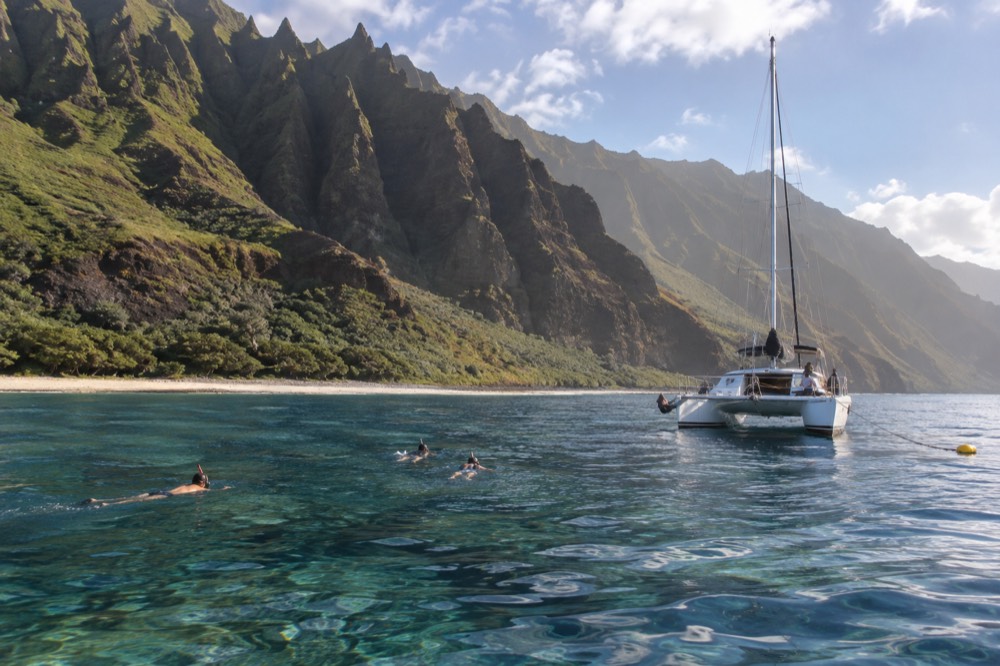
Wildlife is a bonus that arrives on its own schedule. Spinner dolphins work the channel on many crossings, sea turtles rest on the inner reefs, and from December through March humpback whales pass Kauai in numbers, though federal law keeps every vessel at least 100 yards from a whale. The whales and the big winter swell arrive in the same months, which is worth knowing before you build your whole trip around a January crossing. A calmer summer morning is the more reliable bet for a first boat day.
The boat also wins on time. A 5-hour morning tour spends roughly two hours running the coast itself and the rest on the crossing, the snorkel stop and lunch, so a single departure covers sightseeing, caves and swimming. Compare that with a helicopter, which crosses the whole coast in a few minutes, or the trail, which needs a full day for the first two valleys and a permit for anything beyond.
What Can You See From The Air?
From the air you see the scale of the coast, the interiors of the valleys, the back of the range and waterfalls that never reach the sea, all in roughly 45 to 55 minutes. Federal rules keep Hawaii air tours at least 1,500 feet above the surface outside of takeoff and landing, so a helicopter sees the whole coast and touches none of it. Published Kauai helicopter rates run from $409 to $499 per person.
The aerial view is genuinely spectacular and genuinely different. A helicopter crosses valleys the boats only see the mouths of, and it is the only way to see the Alaka'i swamp country and the wettest summit country on the island in one sweep. Blue Hawaiian's current Kauai listings price a 50-minute eco adventure at $409 per person and a 45-minute tour at $499, and those figures are worth setting beside the boat roster: the most expensive boat on this site, an 8-hour Ni'ihau expedition with two meals, tops out at $361.31 per person. A helicopter costs more per minute of coast than anything on the water.
The regulation is worth knowing because it shapes what you actually see. The standard minimum altitude for Hawaii air tours is 1,500 feet above the surface, and single-engine rotorcraft on tours beyond the shoreline must carry flotation gear for each occupant and brief passengers on water ditching before departure. Those are serious, sensible rules, and they mean the cliffs you photograph from a helicopter are seen from more than a quarter mile up. The boat view is measured in feet. The aerial view is measured in the whole coast at once.
Where the air wins outright is weather geometry. A helicopter flies when the swell is too big for a comfortable boat crossing, and it sees the coast in winter months when sea conditions are at their roughest. Where it loses is everything else: no caves, no snorkel, no dolphins at water level, no landing at an archaeological site, and no meal. Our longer comparison of the two options works through the trade-offs in detail at helicopter or boat for the Napali Coast.
The honest summary is that the helicopter is a complement, not a substitute. If the budget covers both, the boat shows you the coast and the helicopter shows you the island the coast belongs to. If the budget covers one, the boat is the one that lets you touch the water.
What Can You See On Foot?
On foot you see Hanakapi'ai Valley and beach on a day hike of roughly 4 miles round trip, or the full 11-mile Kalalau Valley with an overnight camping permit. The trail is steep, muddy in places and crosses streams that can rise fast, and beyond Hanakapi'ai a camping permit is mandatory, no exceptions. Day-use entry requires a reservation through Haena State Park at $5 per person.
The Kalalau Trail is the only path along the coast, and the state describes it as 11 miles one way across five major valleys. Most hikers in good condition need a full day each way to reach Kalalau Beach, which is why almost everyone who walks any of it walks only the first two miles to Hanakapi'ai. That day hike needs no camping permit, but it does need the Haena reservation: non-residents pay $5 per person for entry and $10 per vehicle for parking, bookable 30 days ahead, and Hawaii residents are exempt.
Beyond Hanakapi'ai the rules harden. Camping permits cost $25 per night for residents and $35 for non-residents, run a maximum of five consecutive nights, open 90 days in advance, and sell out months ahead in summer. The state is also blunt about a scam worth repeating: it is illegal for anyone to sell commercial boat drop-offs or pickups at the Kalalau or Miloli'i camping areas, so any "boat-supported camping trip" advertisement is not a loophole, it is a crime.
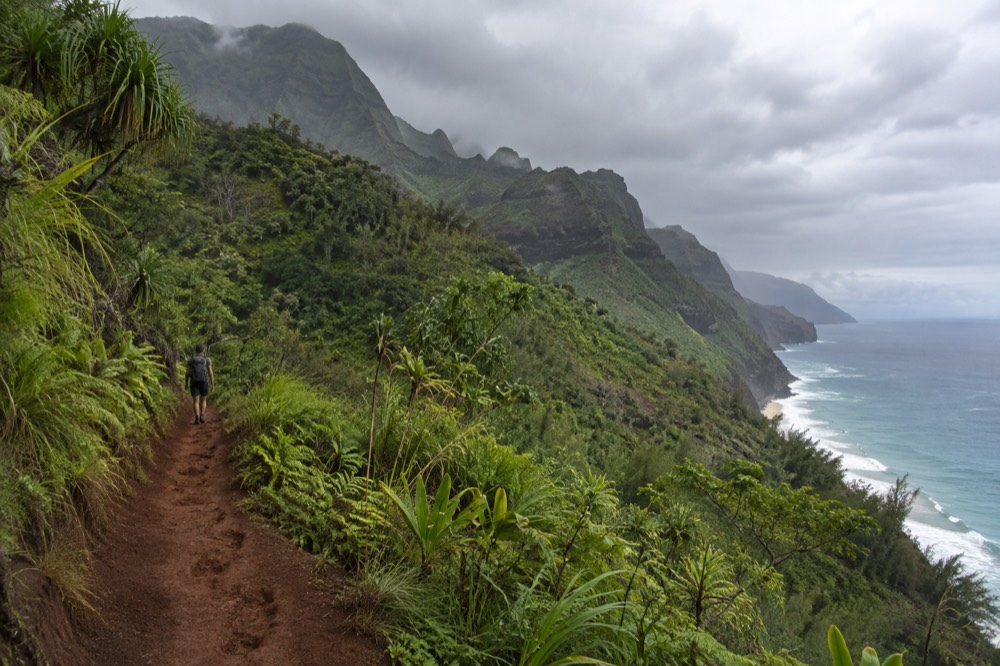
What the trail gives you is the slow version of the coast: the sound of the valleys, the terraces under your boots, and a view of the cliffs that changes with every switchback. What it costs you is a full day, a serious cardio effort, and a gamble on trail conditions. The trailhead is on the north shore, roughly 41 miles and an hour and a half from Lihue Airport, so a trail day and a west-side boat day cannot share a morning. Anyone planning both should read the full trail breakdown at the Kalalau Trail guide.
For most visitors the trail is the backup, not the plan. It is the right answer for a fit hiker with a spare day and a reservation secured weeks ahead, and the wrong answer for everyone else, which is most people on a one-week Kauai trip.
What Can You See From A Lookout?
From a lookout you see a framed slice of the coast, most famously the view from the Kalalau Valley Overlook in Koke'e State Park, roughly 4,000 feet above sea level. It costs a park entry fee and a winding drive, it takes an hour, and it shows you the coast from so far away that the ocean reads as a texture. It is the cheapest option and the least immersive one.
The lookout deserves a fair hearing because it is the only way to see the coast that fits any budget, any fitness level and any weather. The Kalalau Valley Overlook puts the whole amphitheater of the valley in one frame, and on a clear day it ranks among the great views in Hawaii. Koke'e Road is public highway and costs nothing to drive, but entering Koke'e State Park is paid for non-residents, and the climb up from Waimea adds switchbacks and fog. Photographers value it for exactly the reason hikers do not: it compresses the coast into a single composition.
What it cannot do is everything the other three options exist for. There is no water, no caves, no wildlife at eye level and no sense of the cliffs' height, which is the single thing that stuns people on a boat. The lookout is the coast as a picture. The boat is the coast as a place. If the whole family cannot board a raft, a lookout day paired with a shorter boat product is a reasonable compromise, and the overview at Napali Coast Boat Tours lays out which shorter tours fit that plan.
There is one more honest note. The overlook is on the weather's schedule more than any other option, because it depends entirely on visibility from 4,000 feet up, and Kauai's interior clouds over without warning. A boat trip cancelled for swell can often be rebooked the next morning; a lookout day lost to fog is just lost.
How Do The Costs Compare?
Boat tours on this roster run from $190 to $361.31 per person, with most full-coast products between $215 and $275 and meals included on nearly all of them. Helicopter tours run from $409 to $499 per person for under an hour. The trail costs $5 entry plus $10 parking for a day hike, or $35 per night to camp. The lookout costs a park fee and a tank of gas.
The price gap is bigger than most visitors expect, and it widens per hour. A 5-hour raft snorkel tour at $217 per person with breakfast included works out to roughly $43 an hour of coast. A 45-minute helicopter flight at $499 works out to more than $11 a minute. The trail is nearly free in dollars and expensive in time, one full day for the short version and two days plus a permit for Kalalau.
| Way to see the coast | Typical cost per person | Time on the coast | What is included |
|---|---|---|---|
| Raft tour (3 hours) | From $225 to $235 | About 2 hours along the cliffs | Snacks, cave runs when conditions permit |
| Catamaran tour (5 hours) | From $215 to $275 | About 2 to 3 hours along the cliffs | Lunch or breakfast, snorkel stop |
| Sunset cruise (3 to 5 hours) | From $190 to $263.82 | Evening run along the coast | Dinner or late lunch |
| Helicopter (45 to 55 minutes) | From $409 to $499 | A few minutes over the coast | Flight only |
| Kalalau day hike | $5 entry, $10 parking | A full day, 2 valleys | Nothing guided |
| Kalalau overlook | Park entry fee | As long as you like | The view |
Two costs hide in the fine print. Every tour price on this roster carries Hawaii's general excise tax baked in or added at checkout, and the state rate plus Kauai's county surcharge comes to 4.5 percent on most transactions. And the cheapest tour is not always the cheapest decision: a $190 express sunset trip gets you on the water, but a $235 raft gets you into the caves, which is the part of the coast people remember. Our full cost breakdown at how much a Napali Coast boat tour costs runs the numbers tour by tour.
Free cancellation is standard across this entire roster, which quietly changes the math. Booking the boat early in your stay, or even before you fly, costs nothing extra if plans shift, and every operator's live listing states its own window.
Which Runs In Which Season?
Boat tours from the west side run year round, conditions permitting, with the calmest, most cave-friendly months roughly April through October. Helicopters fly in almost any weather the boats do not want. The Kalalau Trail is hikeable year round but wettest in winter, and the lookout is open whenever the clouds are not sitting on it. The whales, December through March, arrive with the biggest swell.
The season question is where most travel writing goes wrong, so it is worth being precise. The dates 15 May to 7 September that get quoted everywhere are the kayak and Miloli'i landing rules, not a boat season. Motor-boat tours out of Port Allen and Kikiaola run all year, and the operators say so on their own pages. What changes through the year is the product mix: which tour runs, how long it is, whether lunch is on it, and how likely the captain is to take a raft inside the caves.
The sea state drives all of it. Measured buoy data off the island's north shore shows summer months, June through September, essentially never recording large offshore wave heights, while December and January record rough seas around half the time. April and October are the real shoulder months, calmer than their reputation. The same winter months that bring the big northwest swells bring the humpbacks, so a January boat day trades cave odds for whale odds.
| Season | Boat tours | Helicopter | Kalalau Trail | Lookout |
|---|---|---|---|---|
| April to May | Calm mornings, cave odds rising, full product mix back | Good flying weather | Drier, permits easier than summer | Clear mornings common |
| June to September | The best window: calm seas, caves usually possible | Good, book ahead for summer | Hot, permits sell out months ahead | Clear, busiest |
| October to November | Shoulder: good mornings, fewer cave runs | Good | Trail in good shape | Increasing cloud risk |
| December to March | Runs year round from the west side, rougher crossings, whales in the channel | Flies when boats cancel | Muddy, streams up, fewest hikers | Often clouded over |
The practical reading of that table: if the caves are the reason for the trip, aim for the April-to-October window and take a morning departure. If the whales are the reason, take the winter boat and accept a bumpier ride, and know that winter whale products from some operators run along the south shore rather than the Napali Coast itself. The full month-by-month picture is at the Napali Coast boat tour season guide.
Which Should You Book First?
Book the boat first, book it for the first full day of your stay, and book a morning. That ordering gives you a rebooking window if the ocean cancels, it puts you on the water in the calmest part of the day, and it lets everything else, helicopter, trail or lookout, fill the days around the one experience you cannot get any other way.
The sequencing advice is the part veteran visitors pass on and first-timers learn the hard way. Operators themselves recommend booking early in your stay so there is room to reschedule if conditions turn, and cancellation notices can come as little as hours before departure. A boat booked for your last day that gets cancelled is a Napali trip with no Napali in it. A boat booked for day one that gets cancelled becomes a story and a rebooking.
Within the boat decision, the format follows the group. Families and anyone prone to seasickness lean toward a power catamaran: stable, spacious, lunch included, and the Amelia K's 4.9 rating from 2,050 reviews reflects a product that has been refined for exactly that customer. Adventurous travelers without back or neck problems, and not pregnant, lean toward the raft, because the raft is the cave boat and the small group, at most 14 guests on some departures, keeps the coast quiet around you.
The long raft morning is the one most worth clearing a day for. The raft snorkel tour from Kauai Sea Tours runs 5 hours 30 minutes, includes breakfast, holds at most 14 guests, and is rated 4.8 from 1,656 reviews, from $217 per person.
Then the short, sharp version for anyone short on time or nerve. The Zodiac raft sea caves expedition out of Kikiaola compresses the whole cave experience into 3 hours, from $235 per person, rated 4.9 from 155 reviews, and it is the tour this page keeps coming back to for a reason: it is the purest hit of the coast's most distinctive feature.
Everything else slots in after the boat is secured. A helicopter can be booked once you are on island, because its weather window is different and its seats are less seasonal. The trail needs its reservation made weeks ahead if you want it at all. The lookout needs nothing but a car and a clear afternoon, which is exactly why it is the plan you never have to plan.
Common Questions About The Napali Coast
What Is The Best Way To See The Napali Coast?
For most visitors, a boat tour from the west side of Kauai, and specifically a rigid-hull raft if the sea caves are the priority. The boat is the only option that reaches the base of the cliffs, the caves and the reefs in a single morning, at a fraction of the helicopter's per-minute cost.
Can you see the Napali Coast without a boat?
Yes, three ways: a helicopter flight, the Kalalau Trail from Haena State Park, or the Kalalau Valley Overlook in Koke'e State Park. All three show you the coast, none of them reach the water, and only the trail takes more than a couple of hours.
Do catamarans go inside the sea caves?
Generally no. Operators state that large catamarans are too tall, wide and deep-drafted to enter safely, so they cruise close to the cave mouths instead. Rigid-hull rafts are the reliable cave boat, and even then entry is always at the captain's discretion and never guaranteed.
Is a helicopter tour better than a boat tour?
They show different things. The helicopter shows the scale of the island and the interior valleys in under an hour, from at least 1,500 feet up. The boat shows the cliffs at eye level, with snorkelling and cave runs, for several hours and several hundred dollars less. If you can only book one, book the boat.
What is the cheapest way to see the Napali Coast?
The lookout, which costs only park entry and gas. The cheapest way on the water is an express sunset trip from $190 per person, and the cheapest full-coast morning tours start at $215 with a meal included.
When should I book my Napali boat tour?
For the first full day of your stay, in the morning. That leaves rebooking room if the ocean cancels, and mornings carry the calmest conditions and the best cave odds. Every tour on this roster offers free cancellation.